Sunday, 6 October 2019

A Dog's Life

Fairly or unfairly, many nationalities have acquired some fortunate or unfortunate reputations. 

The Germans love slow beer, fast cars and even faster sex.  The latter evidently also appeals to some foreign women who have been known to quite literally drag a German into a cupboard for a quick ravish; exchanging bodily fluids faster than most of us could exchange business cards.

Previously unseeded Russian model Angela Ermakova beat Boris Becker game, set and match plus child maintenance, custody and a personal sporting fortune of US$ 25m in a frenzied match lasting just 5 seconds
 - played in a broom cupboard no less.

https://www.ibtimes.co.uk/boris-beckers-five-second-sex-cupboard-has-cost-him-his-fortune-1627401


https://www.telegraph.co.uk/news/worldnews/europe/germany/1445893/Becker-tells-of-his-night-of-torment-tears-and-five-second-sex-in-a-broom-cupboard.html


The Swedish, on the other hand, are smoking hot. 

Old Swedes: ABBA, hotter than ever with 380 million record sales and two successful Mama Mia musicals spanning a musical career which started in 1974 

New Swede: Elin Nordegren, formerly Mrs Tiger Woods;
settled for a mere US$20m per year of their 5 year marriage 

- while also proving herself proficient with a golf club when angered

Meanwhile an obsession with the weather has long been as indelibly British as the old, blue passports used to be. Many non-white British ruefully observe that the only way they can prove their Britishness when travelling abroad, is by ceaselessly wittering on about "... what a fine day it turned out to be ..." in whichever country they are visiting.  Such conversation can seem a little misplaced, for example, during the total lack of daylight in the depths of the Finnish winter, but this only serves to further reinforce the eccentric British identity. 


Despite leading the world in fields as diverse as home electronics, shipbuilding and nuclear reactors, most outsiders squeezed to comment on Korea will invariably reference eating dog meat. Mike Huckabee, the father of the routinely routed and publicly pilloried Whitehouse press secretary Sarah Huckabee, certainly didn't disguise his southern baptist sensitivities when declaring;


"I trust Bernie Sanders with my tax dollars like I trust a North Korean chef with my Labrador!"

Huckabee's political aspirations then ejaculated prematurely with clumsy justifications of his jokes such as;

"People manufacture their offenses. 
So even if there's nothing to be offended about, 
they can pretend that they're offended,
so that they can demand an apology, demand a retraction." 


https://www.buzzfeednews.com/article/andrewkaczynski/huckabee-my-north-korea-dog-eating-joke-was-factual-obama-ad


Meanwhile, an ocean apart in distance, culture and humour, some Koreans are tiring of the dog-meat-eating stereotype; asking why the same practices, found more widely in China, India and South East Asia do not attract as much media attention as they do in Korea.

https://zenkimchi.com/commentary/2018-koreans-eating-dog-meat-meme-racist/

https://www.ranker.com/list/cultures-that-eat-dogs/laura-allan

Always remembering of course that back in Europe, the rationing of food after World War 2 left many people with no choice but to eat tabby and ginger "Roof Rabbits", as well as conventional floppy-eared bunnies, due to the dire shortage of meat which was available.

https://en.m.wikipedia.org/wiki/Cat_meat


This summer Kim Basinger attended a rally in Seoul calling for an end to the eating of dog meat in Korea, highlighting the juxtaposition that dogs are increasingly popular companion pets throughout the country.


The actress Kim Basinger in Seoul in July 2019
- carrying a mock dog carcass to raise awareness about dog cruelty
https://www.google.com/amp/s/amp.scmp.com/news/asia/east-asia/article/3018374/us-actress-kim-basinger-leads-protests-dog-meat-day-south-korea


Aside from the noble cause and the rare glimpse of celebrity, the event was also notable for the counter-demonstration held across the road where people defiantly exercised their right to eat dog meat by deliberately sitting down to eat generous portions of steamed mutt - with kimchi, naturally.


Many studies suggest that these days it is primarily Korea's old-timers who still have a taste for dog meat dishes.  Consumption is reportedly declining  by approx 20% - 30% each year with possibly as few as 20% of the population actually having eaten dog meat in the last year.  There are now estimated to be only ~300 dog meat restaurants remaining in Seoul with annual consumption across the country at less than a million dogs for a population of approx 50m people.  

However, some reports suggest a virtual renaissance in canine cuisine;

http://theseoultimes.com/ST/?url=/ST/db/read.php?idx=113

In reality the meat is tough, stringy, quite oily and not particularly tasty so youngsters have long since preferred almost anything but mutt. 


Boshintang: dog meat stew - not really embraced by the young generation

http://www.koreabiomed.com/news/articleView.html?idxno=257

In a country where the frequencies of dating, marriage and childbirth are reducing while the frequency of divorce (increasingly initiated by emasculated wives) is rising, dogs are indeed increasingly important as companion animals for many single people.

With over 90% of Koreans living in cities, many in high rise apartments of less than 30m2, small breeds such as Pomeranians weighing typically 4kg are the most popular. 

https://www.google.com/amp/mengnews.joins.com/amparticle/3064715

https://www.japantimes.co.jp/news/2013/09/17/asia-pacific/social-issues-asia-pacific/after-decades-of-growth-south-korea-is-now-a-land-full-of-apartments/#.XY1X2VMRU0M
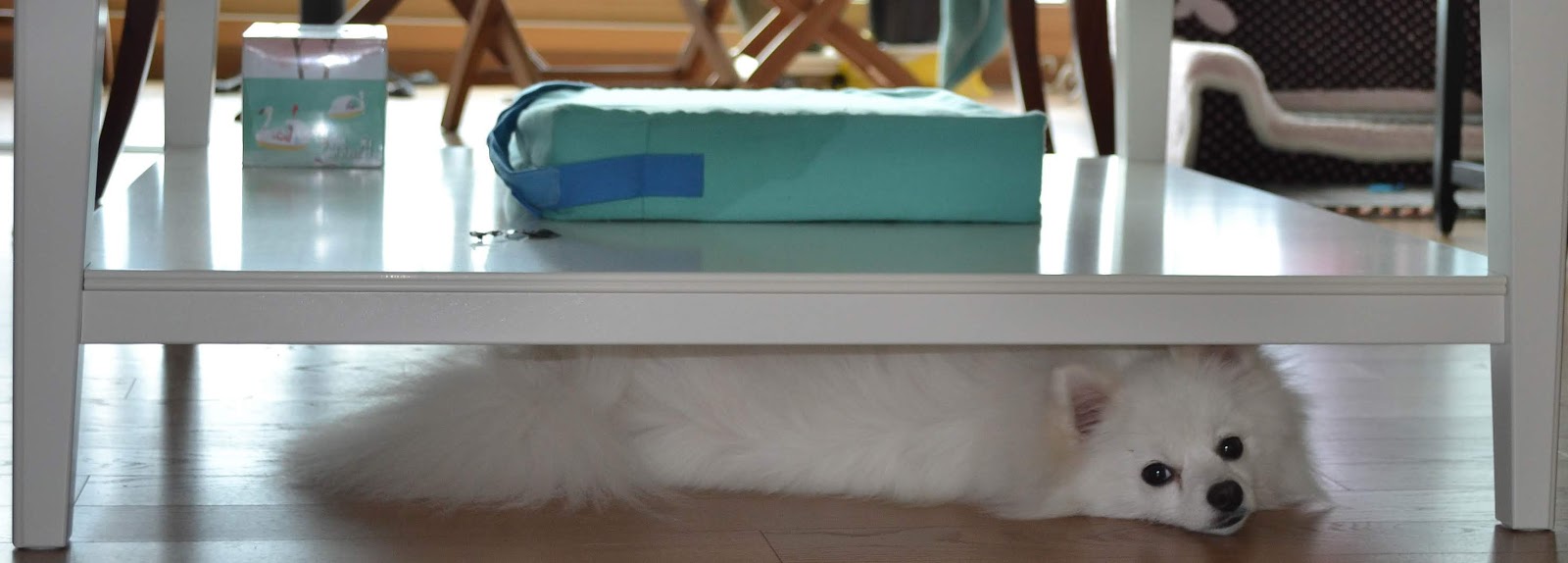

Dust Mutt: for apartments dwellers, 'toy' dogs weighing just 4 or 5 kg are ideal for
cleaning dust from places which are difficult to reach - like under the coffee table

 A few years ago it was not unusual to see young couples pushing pampered poodles in dog strollers as they proudly cruised the malls at the weekend. Today many malls no longer insist on the use of strollers, allowing dogs to be walked on a leash, not only through the communal mall areas but actually inside the individual shops.  


No strollers required; dogs can now be walked through malls and shops

Indeed most malls have no shortage of pet shops, groomers and pet cafes where owners can leave their dogs to socialise for a few hours while the owners enjoy a quiet lunch.


Although apartment dwellers tend towards small pooches, there are notable exceptions, including a good friend who survived the best part of 3 years in a 130m2 apartment with 2 dogs weighing 40 to 50 kg each. The small confines of the apartment were a poor substitute for the wide open spaces which the dogs were accustomed to in Texas, so they obviously looked forward to their daybreak walks with unrestrained enthusiasm.  In his apartment block, many early mornings were punctuated by the blood-curdling shrieks of little old ladies who had been patiently waiting in front of the elevator, only to find themselves suddenly face-to-face with two panting, drooling, hell-hounds standing over a metre high, bursting from the opening doors. Reassurances that the dogs were daft, harmless and just wanted to play were ... unconvincing.


Sadly, for every dog being pampered, there are others barely eeking out a scared and miserable existence. 

https://www.huffingtonpost.co.uk/entry/rspca-cruelty-statistics-dogs-most-abused-pet-uk_uk_56f1544be4b0fbd4fe08a272


One Sunday under the Mapo bridge I stopped to admire a beautifully groomed pedigree dog whose size seriously rivaled that of a small horse. Normally such a huge and powerful dog would have the confidence to walk untroubled through the tides of people moving calmly around him. Instead this dog was shy, nervous, walking close to his owner's legs and constantly looking up to his owner's face for reassurance. He was essentially a nervous wreck. The owner explained that the 83kg dog was now mostly rehabilitated, having been found 2 years earlier weighing a mere 13kg; chained, beaten, tortured, bald, diseased, unfed and crying in fear of every human who approached him. It was impossible to know how many years he had been kept captive in these conditions. Restoring his physical health had taken a long time; restoring his mental health would take much longer.


Sad as it was, I dismissed this as a rare case of extreme cruelty by an owner with a mental, social or criminal profile whose sadistic abuse of a captive victim somehow made him feel better about himself. However cruelty is certainly not limited to the underprivileged.  Two years later in an affluent subdivision of EunPyeong-gu, where successful businessmen commission architects to design their bespoke villas in the foothills of Bukhansan National Park, I walked past a 4 month old puppy, whining and shivering in heavily falling snow.  It was 9pm in the evening, the temperature had already dropped below -8°C and being the end of February, it was pitch-black dark with a bitterly cold wind. The puppy was patiently waiting outside the front door of a house while his humans ate, warm and cosy, in front of the TV.  The dog kennel they provided was already too small for the puppy and in any case the kennel door was closed, so it was impossible for the puppy to get inside for shelter.

When I asked my friend about this, he was unconcerned, explaining that Jindo dogs are famous for their tolerance of harsh conditions; they are bred and trained from an early age to endure discomfort and hardship - it builds strong senses of duty and loyalty which are important for guarding both the property and owners against intruders. However, this was no hardy breed of Jindo dog it was simply an unfortunate Golden Retriever puppy, bought by wealthy parents as a quick-fix-gift to satisfy their spoilt, sofa-slug son at Christmas.  Obviously nobody could be bothered to house-train the puppy so when they tired of him messing in the house they simply put him outside in a steel cage the size of a small coffee table and gave him bones twice a week - out of sight, out of mind. 


Beautiful bespoke family home with unwanted Christmas gift
- perpetually bored and ignored Golden Retriever 

In the 4 months which followed the puppy grew to completely fill his cage; he was never walked, played with, washed or groomed. When the family left the house or came home, the parents and the kid walked past the puppy like he was not even there. In the first few months, the puppy ran enthusiastically along the garden fence to greet passers-by; trying anything to establish some form of communication with someone. However after a few months the family did not like others befriending the dog so they locked him permanently in his cage.

"Better humans wanted - please apply"

On the rare occasions the cage was opened, the puppy walked lethargically, with head hung low between his shoulders, tail limp, eyes down. He was not even a year old but he had lost interest in everything. He was filthy outside and dead inside.  Ultimately, cruelty by neglect is little better than cruelty by abuse.  By June, before he could celebrate his first birthday, the puppy had disappeared altogether from the family home, not to be seen again.  

https://www.hsi.org/issues/dog-meat-trade/

Growing public awareness is gradually inspiring volunteer groups to organise support for a lucky minority of unwanted mutts.  Seoul's Itaewon has long been famous with foreigners for it's late night bars and early morning brawls.  Now on Sunday mornings, while some nurse their hangovers, others are nursing, grooming and pampering unwanted dogs in makeshift yellow tents erected on the pavement at the west end of Itaewon's main drag.   

Second chances : new homes for a lucky few thanks to time given by volunteers in Itaewon
The tents are only set up for the day, staffed by a small number of youngsters, to allow the dogs out of their cages, to play with each other, enjoy some face time with passers-by, have their chins tickled, their tummies rubbed, their ears fondled.  Most people stop for a few minutes to take a few photos before eventually moving on but importantly this gives the dogs the chance to meet caring humans in a safe environment and to enjoy some free hugs, perhaps some fleeting affection and just maybe it gives them a shot at finding a new home. 


Saturday, 9 March 2019

Out And About In Hong Kong

Bob Dylan: more relevant than ever to politicians on both sides of The Pond;
"Don't criticise what you can't understand"

Last August, one of the most cocky spring chickens of the 1960s confidently ambled onto a modest stage perched in the cavernous rafters of Hong Kong's vast Convention & Exhibition Centre. Now a venerated old bird, at the rude old age of 77 a comfortably craggy Bob Dylan took centre stage to crow out, once again, that amongst many other certainties in life, we are all "...gonna have to serve somebody". In perhaps no other city in the world is this truth more seamlessly woven through the daily lives of its inhabitants. Endless pages have been written about old Hong Kong; from the opium wars to the Kowloon Walled City. Perhaps more has been written about modern Hong Kong; the lavish skyscrapers by Sir Norman Frosty or the 'new' Chek Lap Kok airport built in the sea. However for a huge number of people in Hong Kong, life is all about service. 

https://www.scmp.com/news/hong-kong/article/1191748/kowloon-walled-city-life-city-darkness


Spielbergian skies over Hong Kong Island's famous northern waterfront 
- transformed by prestige architects


Anyone in primary school in the 70s will remember most of their toys were stamped with the familiar words 'Made in Hong Kong'. However by the early 80s, China's social reforms encouraged most of HK's manufacturing to move to the mainland, together with much of its male workforce. 

While HK's departing industry was quickly replaced by service businesses such as finance and consulting, the departing male workers were quickly replaced by Hong Kongese women.  Then suddenly family households needed cooks, cleaners and nannies (Domestic Helpers, DH) at home.  This coincided neatly with the policy of the Philippines' wily president Marcos to export all of his problematic unemployed abroad. He was very successful and in the 20 years which followed, Indonesia, Thailand, Sri Lanka and Nepal also tried their luck with the same Marcos model. 


View from Hong Kong over Victoria Harbour to Kowloon.
Now a monument to finance and consulting.

In Korea in 2015 it was estimated that 2.5% of families employed a Domestic Helper (DH). These are almost exclusively Chinese-Koreans since immigration laws restrict such work to ethnic Koreans only. This is designed to avoid the (perceived negative) impact of foreign cultural contamination in Korean homes.  The policy not only runs contrary to foreign teachers being allowed to teach English to school children but also the fact that many parents consider an English-speaking nanny as a learning advantage for their children.  However, as the law stands, it is taken very seriously by Immigration, as Korean Air heiress Heather Cho found out in 2018.


Heather Cho, celebrated for commandeering a departing plane on the tarmac at JFK airport because she was served macadamia nuts without a silver tray, this time answering allegations that she circumvented immigration law by hiring Filipino Domestic Helpers as 'Korean Air trainees' 
https://coconuts.co/manila/news/korean-air-heiress-infamous-airplane-nut-rage-accused-hiring-filipino-domestic-workers-illegally/

http://m.koreaherald.com/view.php?ud=20180617000217#cb 

In a total Korean population of 50m people, estimates are that 30,000 to 80,000 people work as DHs, typically earning just under US$1,000 per month. 

By comparison, up to 33% of Hong Kongese families are estimated to hire DHs, amounting to 350,000 people or 5% of a total HK population of 7.5m. DHs are almost all female, split 50:50 Filipino:Indonesian, mostly in the age range 20 to 45 and typically earning US$500 per month.

In Hong Kong, DHs are legally obliged to live with their employers. Their day starts very early as they prepare breakfast for the family, get children washed and dressed for school and quite possibly deliver them to school also. The day is then filled with food shopping, cooking, washing, cleaning and then collecting children, feeding them, washing them and getting them to bed before the return of the parent(s). 

There is a lot to do so it is a long day, often finishing after 9pm, which explains why most DHs are not highly visible Monday to Saturday. Sunday however is the customary day off, when many DHs go to worship before collecting in the city's parks and open spaces to share food with friends, make video calls to the family back home and to fall asleep in the shade to the comforting background chatter of their native tongue.

Road closed for dancing in the street; a typical Sunday in Central in HK
Domestic Helpers set up impromptu food and dance parties in the city's open spaces.

Noodles and kick-boxing make for a relaxing afternoon

'Pretty maids all in a row';
Sunday in the park after worship; headscarved Indonesians to the left and Filipinas to the right.

While a foreigner in Korea still usually finds themselves the only non-Korean on the subway, in the supermarket or at the bar, in HK the ethnic mix could not be more complete. There are people from every corner of the world attracted by the combination of high salaries, low taxation and lenient requirements for work permits and residency. Of course in mid-summer this still feels like miserable compensation for the infernal heat and oppressive humidity. To adapt an old line from General Sheridan; "If I owned Hong Kong and Hell, I'd rent out Hong Kong and live in Hell." 

https://en.wikiquote.org/wiki/Philip_Sheridan

Permanent residency can be acquired after 7 years of living legally  in Hong Kong.  However, controversially, this excludes people working as Domestic Helpers.  Some have mounted legal challenges to this but so far these failed.

https://en.m.wikipedia.org/wiki/Vallejos_v_Commissioner_of_Registration

Although English serves to connect most people in HK, it is interesting to note that a common language does not in itself deliver real social integration.  On Sundays it is quite normal to see a group of Filipinas having an impromptu zumba under some trees while head-scarved Indonesians sit reading and chatting in a separate group nearby. Meanwhile two blocks away there will be English, Irish, Aussies and Yanks downing beers and following their own national sports in their separate home-styled bars.  This shows that social integration occurs between people with shared histories, experiences, values and beliefs; it requires much more than simply speaking a common language.  


Braving a summer squall in Taymar Park: an open air screening of The Rocky Horror Picture Show (1975) attracts people of all nationalities to come and get wet together

If there is any ethnic-unifying culture in Hong Kong then this is most visibly simply money.  The striking number of jewelry shops, even in the most bland malls and socially humble residential areas shows a pre-occupation with bling; see and be seen, get it and show it to everyone on My-Life-Is-Better-Than-Yours.com


A Lotus get-away car for the groom; cheap and tacky but unusual
(just like his boots and haircut) 

Anyone taking the popular, open-topped city tour bus ride will have seen The Pawn as they pass all the famous land marks of Hong Kong.  The building dates from 1881, was formerly a pawn shop and was since reinvented as an upmarket bar and restaurant.  Here you can take green tea on the balcony while peering down your nose at the great unwashed for just US$14; the same list price as the Guinness.  Bottles of spirits are priced at 5 times their respective duty free prices, which puts a bottle of champagne at about US$350.  At such places it is unremarkable to see a young couple, barely in their 20s, order a bottle of Moet, drink one glass each while waiting for friends and then leave the rest of the bottle as they move onto their next venue.  

The Pawn on Johnston Rd, Wanchai

Hong Kong's WanChai; a place where the high-life and low-life rub shoulders.
If you drop US$300,000 you can walk out with a McLaren on 20" wheels.
If you drop US$300 you can walk out with an hour's worth of intimate company on 3" heels.
Good quality rubber is essential for both options.

A six-decked yacht named 'Diamonds are Forever'
sits idle month after month in a marina overlooked by the Gold Coast Hotel

Proving that absurd advertising does not detract from its success.
The current must-have item for HK's male and female professionals alike
- chunky gent's watches by Omega, or at least, strikingly good imitations thereof.

As a social model, HK demonstrates how different cultures can live, drive and survive together without being assimilated into the culture of the host country. A healthy mutual respect, a live-and-let-live attitude and a common observance of the law can be enough.  This should reassure those Koreans who are increasingly panicked by the popular media about the rising numbers of foreigners in Korea and the potential erosion of Korean culture. 


Friday, 15 February 2019

Just Say "Aaaggghhhh !"

Alien 1979: "In space, no one can hear you scream".
In any competition  involving teeth, Korea wins every time
This week Seoul was chosen as the South Korean city which will  bid jointly with North Korea for the Olympic Games of 2032.  

http://www.koreaherald.com/view.php?ud=20190211000920&ACE_SEARCH=1

It is hard to believe that 30 years have already passed since South Korea boldly hosted the summer Olympics of 1988. These games would go down in history as the event which proudly launched the Korean sport of Oral Hygiene (OH) into the global arena for the very first time. Viewers around the world sat speechless as the host nation carried away every gold, silver and bronze medal, effortlessly beating all foreign competition in every single OH event. 

First up was the eye-wateringly fast 15-Second Power-Brush Dash; ideal just before kissing and caressing or just after a secret cigarette. Then came the precision events such as the Single-handed Interdental Floss. These demonstrated skills patiently perfected over centuries into a near art form by Korean Buddhist Masters to remove their main diet of leafy greens from  between their rear molars. There were also an impresssive range of endurance events such as the Double-Handed Foam Marathon. This showed us for the first time how two beads of toothpaste can be whipped up into an entire mouthfull of foam, with all the uncompromising firmness of a Korean mattress, in just under 20 minutes. Of course the reasons for creating this foam still remain as opaque as, well, the foam itself really. In any case, with these unique and admittedly imaginative skills, South Korea instantly positioned itself at the cleaning edge of global Oral Hygiene. The rest of the world would have to brush up and catch up. 

From such unlikely beginnings, Korea's great Heroes of '88 were instantly immortalized as their as Oral Hygiene routines soon became ritual and are now observed in daily life with the same discipline one would expect of any finely-honed military unit. Official advice is to strictly follow the 3-3-3 concept, that is; to brush 3 times per day, for 3 minutes each time,  within 3 minutes of eating food. Yes. Seriously. Within 3 minutes of eating food.


https://journals.lww.com/md-journal/fulltext/2017/02170/Association_between_oral_health_behavior_and.62.aspx


Sharing is caring: brush together

Lunchtimes for office-dwellers are therefore characterised by fast and furious food around noon, then by a sharp sprint to the washroom armed with brushes, pastes and any number of the latest accessories. Of course the number of sinks are limited so an orderly queue is observed, with obvious deference to seniors who can slip in front of juniors any time, at their leisure. 

Guys in a hurry can at least use an additional evolutionary advantage to jump the queues; they can brush their teeth while standing at the urinals. Given a little practice with a well-disciplined Trouser Snake, one can urinate quite deftly while brushing one's teeth with one hand and posting on Facebook with the other hand. Those who eat a larger lunch take their brushes and mobiles into the cubicles to somehow combine their ablutions and social media updates at a more relaxed pace while seated. It is little wonder that recent studies showed 18 times more bacteria on the average smart phone than on the average toilet flush handle. 

http://time.com/4908654/cell-phone-bacteria/

None of this means that Oral Hygiene is in any way limited to mere tooth brushing. Frenzied brushing of the teeth in proscribed sets of horizontal, vertical and orbital motions, is merely  a cunning warm-up to flex the finger  muscles required for the more demanding tasks to follow. The first of these is the slow, methodical root-to-tip pressure-scrubbing of the top surface of the fully extended tongue. It amounts to scouring your most sensitive erogenous zone in front of the mirror in public. 


Tongue-scrubbing

Next follows the vigorous up-down scraping of the inside walls of the cheeks, which gives the impression of a large, trapped insect trying to claw its way out from inside the mouth. Finally comes a complete brush down of the entire roof of the mouth. The first time you see this you cannot help wonder if the person is trying to hook the base of their brain so they can pull it out via the soft palate. 

Evidently none of the above are effective unless followed by a complete ensemble of deep throat gargling, three intense mouth-rinse cycles and finally hacking up phlem from the deepest, darkest reaches of the trachea. All of these are accompanied by their own personal combination of gutteral grunts, groans and roars which are normally only heard from moody Scots at Wimbledon.


Game, set and match

Saturday, 12 January 2019

No Sex Please I'm British


Puffer jackets - now a near fetish in Korea 

The silly season has definitely returned to Seoul this winter as December heralded a third consecutive year of obsession-near-fetish as students and adults alike competed to drop anything upwards of US$750 on identical, almost invariably black, ankle-length, duck down quilted 'caterpillar coats'. The knee length or waist length coats of previous years are strictly passé so it is best not to attempt a personal fashion revival by pulling either of these out of the wardrobe - even if you are still paying off the loan for them ! This will just get you de-listed from every event on your social calendar and will guarantee you your very own spotlight on social media. 


Size does matter; the guy on the right is going home alone tonight 
If you cannot afford the Full Monty this year then just stay home in your PJs with Netflix. This confirms you are one of life's 'little people'. 

Life's 'Little People' in Seoul Station subway,
taking refuge from temperatures of -15°C 
in their own padded sleeping bags
Of course, if you can afford to wear what looks like the sleeping bag in which you slept in the subway with the hobos last night, then your style has triumphed over your common sense and you can proudly strut that shapeless, sexless but inexplicably coveted Michelin Man look all over town. 


High school competition is fierce; the longer the better

Aside from the astonishing price of the coats, the social pressure to have the 'reassuringly expensive' brand 'because you're worth it' (brainwashing legacies of Stella Artois and L'Oreal respectively) and the fact the coats will be re-styled next season and therefore obviously unwearable, is the sheer incredible bulk of the coats. They instantly endow a 60kg whispish rake of an office boy with the commanding profile of a Kiwi scrum half. These coats transform a person's stature just like Steve Rogers / Captain America before and after the treatment. All this comes to a head during rush hour on the subway where normal overcrowding is already a game of groans. 


Rush hour on the Seoul subway: busy 
Seoul commuters are quite accustomed to packing into carriages so tightly that anyone can happily fall asleep standing up without any risk of falling over, since there is quite literally no space to fall into. The tight crush of people exerts a supporting pressure on everyone like a jar full of toothpicks. Of course, a carriage is never full; if nobody exits at a particular stop, everyone has to bunch up to accommodate the new onboards. The danger point is recognised when commuters spontaneously begin 'synchronised breathing'. This is when one person inhales while the person next to them exhales; because if everybody inhaled at the same time then the person with the weakest ribs will simply implode into a soggy mess. This is not only traumatic for their travelling companions but also highly inconvenient for the cleaners. The health risks of overpacking become clear whenever the train brakes harshly or lurches on a sharp curve. This is followed by a wave of popping sounds as the shoulders and hips of the most fragile commuters gently dislocate and then re-engage as a surge of crowd-pressure ripples through the carriage.

At peak hours the crush is so acute that it is quite impossible to avoid rubbing erogenous zones with at least six strangers while travelling just three stops. Whether you are rubbing EZs with people of your preferred sex, sexuality, age or physical attributes is very much a lottery - you can only hope to get lucky once in a while. Essentially, subway commuters are willingly engaging in the foreplay of a fully public orgy which they have not actually consented to.


The daily commute; agony and ecstasy - the public orgy you didn't consent to

Just this week one gentleman (I have to assume, since he seemed superficially polite) backed up so close to me that his ear brushed against my lips. Now, as a man of the world I am normally quite adept at stimulating an earlobe or two. A slow combination of warm breath, quiet murmurs, an inquiring tongue, together with some soft nibbles with moist lips and perhaps a gentle bite or two can be a very good starting point for a long and rewarding intimate evening. However it is sadly not the same when some unknown gent half a head shorter than me, drags his earlobe across my lips and tickles my nose with his dyed-black, gel-stiffened, toilet-brush haircut. He assumed this much foreplay from me without so much as a coffee and a little frisky small-talk. I was furious: how easy does he think I am ?
Pupae: unexpected fashion icons

The caterpillar coats and the overcrowded subway present serious social challenges when taken separately. When they combine, they make the morning commute the ultimate test of endurance. At rest, each person is said to emit about 100W of heat. However when wrapped in sufficient insulation to climb the peaks of Pluto, then ram-packed into subway carriages hot enough to grow tomatoes, the average commuter finds themselves cooking in their own juices and, ironically, in danger of passing out from heat stroke. Meanwhile shorter, vertically challenged commuters face the additional risk of being smothered by the taller crowd around them. So effective is the sensory deprivation provided by today's mobiles and noise-canceling headphones that there is no chance of noticing a fellow commuter turn from red via purple to blue and then expiring with a muffled whimper. Yet another dilemma for the cleaners !


Saturday, 27 October 2018

Storm in a tea cup

There is a widely held belief that you can tell much about a person or a nation from the way they handle themselves in a crisis.  

Great leaders of our time, and David Cameron.
The Prime Ministerial spectrum; from the 
original salad dodger to the risible porker porker

Wartime heroism is such a distant memory that the quote most often heard about crises these days is the cynical observation; 

"When the going gets tough, the tough get going". 

In the wake of Cameron's resignation after the Brexit referendum, political satirists joyfully updated this quip to; 

"When the going gets tough, the toff gets off".

This divisive issue continues to dangle British politics over a precipice. With Boris Johnson, Michael Gove and Jacob Rees-Mogg all jockeying for leadership positions, it is still too early to assume the next update will be; 

"When the toffs gets tough, May will stay".

Quotes about crises from people in the public eye range from the sage Dexter Morgan; 

"There's nothing like a crisis to define who you are". 

To the sublime Jeremy Corbyn, who evidently didn't see the current antisemitism storm brewing on the horizon when he shared his wistful thinking;

"I find if you are in an office, the crisis finds you. 
If you're not in the office, the crisis finds somebody else".


Either way, this summer it was the tropical typhoon which provided the barometer by which to measure how different countries respond to a looming weather crisis. 

Most people are aware of the annual monsoon which  gestates slowly before midsummer then unloads torrents of water shortly and sharply over much of India. However the wider geographical area, from North Australia through to China, experiences approx 27 large, heavy storms each year which form quickly, barrel in from the western Pacific Ocean every fortnight and then ping around the archipelagos of south east Asia at the whim of some atmospheric pinball wizard. 


Trajectories of 2018's western pacific typhoons to date

Thanks to weather satellites and cloud penetrating radar, the speed, strength and direction of these storms can be monitored and to some extent predicted. However reacting to the risks is still very much an individual national decision.

Of the average 27 storms, the smallest 10 are usually only of concern to international shipping. The remaining 17 develop into typhoons, most of which make landfall somewhere between the Philippines to the south west and Japan to the north east. While half of these simply deliver long, soggy days of unending rain, the other half form 'super typhoons' characterised by destructive winds and enough rain to cause severe flooding. 


Espana Boulevand, Manila 2014
In some places the rain is manageable; cities have sewers and canals to route water quickly to the river or sea. However deforested hill-sides in rural communities are at high risk as the rain saturates the topsoil, increasing its weight, while simultaneously lubricating the soil so it slides more easily. Unfortunate townsfolk buried under large mudslides are regular events. High winds generate powerful waves and uproot trees while broken overhead power lines have greatest impact, cutting off electricity and thereby also water and gas.


In 2016 South Korea's national weather service proudly hailed the installation of its new Cray weather-predicting Super Computer No4 (SC4). At US $54m it was staggeringly expensive, lightning fast, highly sophisticated, it was the bee's knees; the last word in weather analysis. It would make Korean weather sexy.


Cray supercomputer, a snip at US$ 54m

https://www.forbes.com/sites/alexknapp/2014/06/25/cray-signs-a-54-million-supercomputing-contract-with-south-korea/amp/

Ever critical and always hard to satisfy, it was not long before a dubious public started to comment on significant differences between the weather promised by SC4 and what they were actually receiving. It rapidly became something of a national hobby to check SC4's daily forecast and then watch for the correlation, in much the same way that people might check their daily horoscope and then look for evidence of its predictions as the day unfolded.

http://m.koreatimes.co.kr/pages/article.asp?newsIdx=212464

Criticism rapidly turned to scandal as every man, woman and dog eventually concluded that the forecasts spewed by the new computer were correct less than 50% of the time. This meant in practice, that if the forecast said no rain, then the chances were that you should take an umbrella with you.

A deeper analysis showed that forecasts were indeed more accurate before the new super-computer. What had gone wrong ? Who had ripped off the Met Office and pocketed a fortune ? Who had been duped by a lousy pile of circuitry dressed up with bells and whistles ? The public demanded answers.  Attempts were made to deflect criticism by blaming the extraction of data from the nation's weather satellite Chollian-1.

http://m.koreaherald.com/view.php?ud=20170822000749#cb 


Two years later, after all the outrage, the investigations, the exonerations and the excuses, the dust settled and the public turned their ire to more urgent matters; such as impeaching a president who had never even twittered a tweet. 

In August 2018 typhoon Soulik formed in the western Pacific, looming large and leaning heavily towards South Korea. The bells and whistles on SC4's super circuits warned of the worst typhoon since 2012; the wind speed measured in hundreds, injuries predicted in thousands and property damage expected in millions. Public events were canceled, people stockpiled food and water while others even dusted off the apocalypse survival kits they were gifted the previous summer at the height of Kim JongUn's 2017 attention-seeking, missile-launching, frenzied rite of passage.

Govt and employers even took the astonishing and previously unimaginable step of telling people to "work from home" (a new phrase never previously heard in Korea). This advice was totally unprocessable by most middle managers who still cannot conceive of people working dutifully if they are not in the direct line of sight of a 'superior'. Team leaders attempted to control their colleagues by scheduling as many online video conferences as possible to ensure their team members were awake, properly attired and actively engaged in their duties at home, not just kicking back in their slippers on the sofa with their kids in front of some K-drama. Most notable was the number of family men who ignored the typhoon warnings to brave it to the office. This time not for the usual reason of habitual presenteeism but rather the sly, unspoken truth that with the schools closed and the kids at home with the wife, an empty office offered the most peaceful environment to finish binge-watching on Netflix.

http://m.koreaherald.com/view.php?ud=20180823000573&ACE_SEARCH=1

http://m.koreaherald.com/view.php?ud=20180820000522&ACE_SEARCH=1

In the end typhoon Soulik came and went. The entire nation spent a whole day in total lock down anticipating events of biblical proportions. What happened in most places were simply long, tedious hours of drizzle. Somewhere on the south coast, which apparently took the brunt of the storm, damage rose into the high single digits as an old lady's umbrella blew inside out. Definitely it was the dampest of squibs.

http://m.koreaherald.com/view.php?ud=20180824000589&ACE_SEARCH=1

And the solution ?  Why, to buy a bigger supercomputer of course ! Supercomputer No 5 is already on order at a whopping US$56m to go !

http://m.koreatimes.co.kr/pages/article.asp?newsIdx=243468

Even so, Korea's newest and most expensive number cruncher yet will still rely on the same quality of data from the same satellite used today.

At the current rate the govt is spending anything upwards of US$50m on weather prediction supercomputers every 5 years, or US$10m per year, for predictions which are more often wrong than right.  Meanwhile old folks can make more reliable predictions by simply looking at the weather on the horizon in the direction that the wind is blowing in from and preparing for the same the next day.


Sunday, 30 September 2018

Into Darkness - Extreme Exam Culture

"Beware the Ides of March" by all means but September is never a dull month in any country. In Germany it is the month of the Oktoberfest - nothing less than the holy grail of the calendar year for many. Of course these days the event has been successfully exported worldwide including to both North and South Korea.

Bavarian colours redesigned with military chic.
Capitalising on NK's very highly rated brewing skills, Kim JungUn gave his personal nod 

to a 20 day beer festival in 2016, which is now an annual event in Pyongyang.


Seoul's Grand Hilton Hotel Oktoberfest:
more lederhosen and fewer starched uniforms than our friends in the north

Meanwhile in the more romantic nations of Europe, September sees a slothful return to work following August's closure of schools, small businesses, consultants, etc, to enable the merchants and professionals to rekindle their passions somewhere secluded. 

Alas for most students in the northern hemisphere, September reluctantly heralds the start of the new academic year and in Korea, it is the final count down to Seunung, the College Scholastic Aptitude Test (CSAT) held each Thursday in the second week of November. This is an 8 hour long national marathon of a selection test in which approx 600,000 students compete for positions at university. The importance of this test is difficult to overstate because of the widely held (and largely self-perpetuating) belief that selection to the best university puts you above your peers socially and provides a roadmap to success for the rest of your entire life. To reinforce the gravity of the exam, police control traffic on the day to ensure everyone arrives at school on time, military exercises and civilian flights are postponed to reduce distractions, meanwhile stock markets, banks and govt offices open late to allow parents to burn the midnight oil with their kid the night before.


Today more than ever, across the world and especially in South Korea (whose OECD ranking for graduation rates leaped from #34 to #1 in only 30 years) school and exams are a test of endurance rather than a test of intelligence or a useful foundation for a career. Students learn the facts and are then tested on how much they can remember. Likewise teachers teach-to-the-test; they coach the students on the type of questions they will be asked and the answers to reply with. This seduces some with the inviting short cut of learning only the questions and the respective model answers rather than learning the basic material. These students are quickly revealed when they leave the room 20 minutes into a 3 hour exam because the questions do not include the ones they learned. 

For the last 4 years South Korea has been #1 worldwide
for high school and college graduation rates.
This prompts the Whitehouse to ask what can the USA learn from  SK ?

Defiance
In 2012 a UK teacher proudly confided that she would refuse to implement the govt exams for 6 year olds in her class. She explained that her students were too young to be stressed by exams and that school is for learning and fun. Furthermore it is unfair to assess anyone based on their performance in one particular hour. A listener noted that when they become adults, her class will be regularly assessed, accepted or rejected in much less than an hour, often in just a few seconds.  This will happen every time they walk into a meeting, attend a job interview or introduce themselves to a potential date at a party. As the saying goes; "You don't get a second chance to make a first impression", so why try to avoid the inevitable ?  Why not become good at it by regular practice ? 

May 2016: UK teachers, parents and children protesting against national exams for 6 year olds

The noble teacher might consider that in former times the Korean education system included exams for entrance to middle school and then again for entrance to high school.  Due to grueling pressure on the students, the middle school exam was abolished in 1971. However this simply increased the stakes riding on the high school exam.  Competition in the high school exam then became so feverishly fraught that it was replaced by a lottery system for allocating school places. Ultimately both of these 'fixes' combined to shift all the pressure further along the system making November's Seunung the single, defining, make-or-break, absolute cliff-hanger of a student's application to university. 


Real Life
At school I recall learning how to calculate the inclination of a cannon set at distance S so that a cannon ball fired with velocity V hit would hit the top of a castle keep at height H. I'd like to think that I could do the same calculation today, which would indeed be a fine test of memory. In real life it is astonishingly rare to be given such a well-defined problem to solve and if you are that lucky then computing the answer is rarely difficult. 

An age old maths problem; the ballistic trajectories of cannon balls
- until 2017 also used notoriously by Kim JungUn for launching ICMBs into the Pacific

Real life problems are poorly defined at best and often hidden at worst; they require analytical skills. The first is observation; recognising that there is a problem with a business unit, a production line or a project is a very subtle skill. The second is investigation; correctly identifying which factors contribute to the problem as opposed to other issues which have no influence. Observation and investigation simply define the problem. Then come the follow-up skills; finding options and choosing a solution. Even the best schools and the most hotly contested universities have been excruciatingly slow at coaching future generations in the analytical skills needed for real challenges. The DAX, NYSE & FTSE are littered with examples of businesses which collapsed because nobody recognised anything was wrong (eg: Lehman Bros) or because a company achieved technical supremacy and/or market share with a product for which there was no longer a demand (eg: Kodak). 

Koreans themselves are scratching their heads over this dilemma, noting that despite Korea's #1 ranking for graduates in the OECD, Korea has yet to win a single Nobel prize in sciences.  Commentators identify rote learning as a likely culprit for stifling creative thinking together with the parents' unbalanced obsession with the reputation of certain universities rather than the subject their child will actually study. 

https://www.koreatimes.co.kr/www/nation/2018/09/181_254202.html

http://www.theasian.asia/archives/99165

Returning to the example of the cannon; relevant questions to ask before lighting the gunpowder might include; what makes an artillery attack preferable to undermining the walls, starving out the defenders or better still, confusing the incumbents by rocking up in a huge wooden horse ? Also, are non-adversarial strategies feasible such as starting rebellion among the defenders, converting them into allies or subverting the loyalty of an under-appreciated gatekeeper by offering him a quiet farmhouse with a few sheep tended by a Nordic shepherdess ?

Nordic shepherdess : offers a discrete alternative to military bombardment 

The analytical skills needed to detect and define problems then assess feasible solutions are hard to teach, harder to test and even harder to evaluate objectively. Therefore the education system blithely stumbles on, testing what students can remember; not because this constitutes a good education but simply because exams are easy to operate and everyone receives a standardised  little score for easy comparison.  

Work life
Analytical skills are similarly hard to teach, test and evaluate in a working environment. But rather than admit to the fallacy of annual performance reviews, HR gurus continue to ply their trade by annually launching the latest reincarnation of their review process which is invariably tweaked, overhauled or rebooted to include some enlightening mantra 'pinched with pride' from some uncredited business class in-flight magazine.

It is no surprise that many major corporations shed the yolk of performance reviews as they stepped into the 21st century, starting with tech companies like Dell, Microsoft and IBM but then joined by consultants such as Deloitte, PWC and Accenture, then industries such as GAP, Lear and General Electric.

https://hbr.org/2016/10/the-performance-management-revolution


https://www.mckinsey.com/business-functions/organization/our-insights/ahead-of-the-curve-the-future-of-performance-management

https://qz.com/428813/ge-performance-review-strategy-shift/


Sadly Korean chaebols are generally operated like military units with decisions made by Human Resources rather than managers. Here the annual performance review is essentially abused since the manager is unable to freely score individuals according to merit. Instead the HR dept. proscribes the spread of people who can be scored high (salary rise), middle (no change) or low (salary decrease). The manager must simply decide which to assign to who, even if all the team have done well and nobody merits a poor score - see previous post


Enlightenment
The most important casualty of an exam-fevered education is the joy of discovery - which is ironically the most powerful incentive to study. Students today memorise that the planets orbit the sun, the circumference of the earth is 40,000 km or that the swing of a pendulum is proportional to the square of its length. Today these are given as dry, unremarkable truths, delivered without context of the significance of the discoveries or how they changed the world. Nothing is taught about the curiosity, passion and egos which drove people to discover these truths, the primitive methods used to make the measurements, the wrong theories which were abandoned before the right theory was realised, the personal, religious and political fallout surrounding the discoveries. A student's enlightenment comes from learning how a discovery was made, who believed it, why it was challenged, who ignored it, as much as from the actual conclusion itself. 


Once education is made devoid of enlightenment, reduced to examinable facts which are dull and unmotivating, clearly students will begrudge the best years of their lives being smothered by the inexorable darkness of extreme exam culture. 

1979: Pink Floyd's The Wall; an early warning of darker times ahead


The Bottom Line
Putting educational philosophies and student motivation aside, the bottom line is that the business of education is business, not education.  In South Korea education is a huge opportunity to squeeze everything that parents can afford in exchange for even the most marginal perceived advantage for their children.  Like the market for new smart phones, the market for educational services needs no advertising, no sales pitch, no marketing.  Parents actively seek out each and every conceivable opportunity to upgrade their child's study experience.  

The prize is simple; a place at one of the nation's 3 elite 'SKY' universities; Seoul National Uni., Korea Uni, and Yonsei Uni. These accept the top 2% of students which sometimes leaves the student feeling a little more entitled than his less fortunate peers.

https://www.quora.com/How-does-South-Koreas-education-system-affect-students

Competition for SKY and other high-rated unis used to start in primary school with parents spending on average 20% of household income on private evening crammers (hagwon).  

https://theconversation.com/south-korean-education-ranks-high-but-its-the-kids-who-pay-34430

https://www.telegraph.co.uk/education/10491289/OECD-education-report-Koreas-school-system-a-pressure-cooker-for-children.html

Hagwons routinely teach until 9pm, often later, leaving children so tired that teachers perversely have to allow them to sleep the next day during regular school class.

Today the battle ground has shifted to kindergarten, specifically English language kindergartens which are perceived to be the latest way to nudge your child ahead.  On average places cost an astonishing US$ 900 per month but demand is so high that there are already more than 250 English language kindergartens in Seoul - the most expensive of which cost US$ 2,000 per month.

http://m.koreaherald.com/view.php?ud=20180724000470#cb


Ultimately money secures academic excellence with which to further leverage social standing.  To highjack Netflix's flawless adaptation of Richard Morgan's 2002 dystopian vision of our near future;


"Those with eternal wealth have 
eternal power over those who don't."


Featured post

Just When You Thought it's All Over ...

Let's face it; some men are naturally gorgeous. They are mouth-watering, perhaps even scrumptious; whether they have just been pulled o...