Showing posts with label Korean Air. Show all posts

Saturday, 9 March 2019

Out And About In Hong Kong

Bob Dylan: more relevant than ever to politicians on both sides of The Pond;
"Don't criticise what you can't understand"

Last August, one of the most cocky spring chickens of the 1960s confidently ambled onto a modest stage perched in the cavernous rafters of Hong Kong's vast Convention & Exhibition Centre. Now a venerated old bird, at the rude old age of 77 a comfortably craggy Bob Dylan took centre stage to crow out, once again, that amongst many other certainties in life, we are all "...gonna have to serve somebody". In perhaps no other city in the world is this truth more seamlessly woven through the daily lives of its inhabitants. Endless pages have been written about old Hong Kong; from the opium wars to the Kowloon Walled City. Perhaps more has been written about modern Hong Kong; the lavish skyscrapers by Sir Norman Frosty or the 'new' Chek Lap Kok airport built in the sea. However for a huge number of people in Hong Kong, life is all about service. 

https://www.scmp.com/news/hong-kong/article/1191748/kowloon-walled-city-life-city-darkness


Spielbergian skies over Hong Kong Island's famous northern waterfront 
- transformed by prestige architects


Anyone in primary school in the 70s will remember most of their toys were stamped with the familiar words 'Made in Hong Kong'. However by the early 80s, China's social reforms encouraged most of HK's manufacturing to move to the mainland, together with much of its male workforce. 

While HK's departing industry was quickly replaced by service businesses such as finance and consulting, the departing male workers were quickly replaced by Hong Kongese women.  Then suddenly family households needed cooks, cleaners and nannies (Domestic Helpers, DH) at home.  This coincided neatly with the policy of the Philippines' wily president Marcos to export all of his problematic unemployed abroad. He was very successful and in the 20 years which followed, Indonesia, Thailand, Sri Lanka and Nepal also tried their luck with the same Marcos model. 


View from Hong Kong over Victoria Harbour to Kowloon.
Now a monument to finance and consulting.

In Korea in 2015 it was estimated that 2.5% of families employed a Domestic Helper (DH). These are almost exclusively Chinese-Koreans since immigration laws restrict such work to ethnic Koreans only. This is designed to avoid the (perceived negative) impact of foreign cultural contamination in Korean homes.  The policy not only runs contrary to foreign teachers being allowed to teach English to school children but also the fact that many parents consider an English-speaking nanny as a learning advantage for their children.  However, as the law stands, it is taken very seriously by Immigration, as Korean Air heiress Heather Cho found out in 2018.


Heather Cho, celebrated for commandeering a departing plane on the tarmac at JFK airport because she was served macadamia nuts without a silver tray, this time answering allegations that she circumvented immigration law by hiring Filipino Domestic Helpers as 'Korean Air trainees' 
https://coconuts.co/manila/news/korean-air-heiress-infamous-airplane-nut-rage-accused-hiring-filipino-domestic-workers-illegally/

http://m.koreaherald.com/view.php?ud=20180617000217#cb 

In a total Korean population of 50m people, estimates are that 30,000 to 80,000 people work as DHs, typically earning just under US$1,000 per month. 

By comparison, up to 33% of Hong Kongese families are estimated to hire DHs, amounting to 350,000 people or 5% of a total HK population of 7.5m. DHs are almost all female, split 50:50 Filipino:Indonesian, mostly in the age range 20 to 45 and typically earning US$500 per month.

In Hong Kong, DHs are legally obliged to live with their employers. Their day starts very early as they prepare breakfast for the family, get children washed and dressed for school and quite possibly deliver them to school also. The day is then filled with food shopping, cooking, washing, cleaning and then collecting children, feeding them, washing them and getting them to bed before the return of the parent(s). 

There is a lot to do so it is a long day, often finishing after 9pm, which explains why most DHs are not highly visible Monday to Saturday. Sunday however is the customary day off, when many DHs go to worship before collecting in the city's parks and open spaces to share food with friends, make video calls to the family back home and to fall asleep in the shade to the comforting background chatter of their native tongue.

Road closed for dancing in the street; a typical Sunday in Central in HK
Domestic Helpers set up impromptu food and dance parties in the city's open spaces.

Noodles and kick-boxing make for a relaxing afternoon

'Pretty maids all in a row';
Sunday in the park after worship; headscarved Indonesians to the left and Filipinas to the right.

While a foreigner in Korea still usually finds themselves the only non-Korean on the subway, in the supermarket or at the bar, in HK the ethnic mix could not be more complete. There are people from every corner of the world attracted by the combination of high salaries, low taxation and lenient requirements for work permits and residency. Of course in mid-summer this still feels like miserable compensation for the infernal heat and oppressive humidity. To adapt an old line from General Sheridan; "If I owned Hong Kong and Hell, I'd rent out Hong Kong and live in Hell." 

https://en.wikiquote.org/wiki/Philip_Sheridan

Permanent residency can be acquired after 7 years of living legally  in Hong Kong.  However, controversially, this excludes people working as Domestic Helpers.  Some have mounted legal challenges to this but so far these failed.

https://en.m.wikipedia.org/wiki/Vallejos_v_Commissioner_of_Registration

Although English serves to connect most people in HK, it is interesting to note that a common language does not in itself deliver real social integration.  On Sundays it is quite normal to see a group of Filipinas having an impromptu zumba under some trees while head-scarved Indonesians sit reading and chatting in a separate group nearby. Meanwhile two blocks away there will be English, Irish, Aussies and Yanks downing beers and following their own national sports in their separate home-styled bars.  This shows that social integration occurs between people with shared histories, experiences, values and beliefs; it requires much more than simply speaking a common language.  


Braving a summer squall in Taymar Park: an open air screening of The Rocky Horror Picture Show (1975) attracts people of all nationalities to come and get wet together

If there is any ethnic-unifying culture in Hong Kong then this is most visibly simply money.  The striking number of jewelry shops, even in the most bland malls and socially humble residential areas shows a pre-occupation with bling; see and be seen, get it and show it to everyone on My-Life-Is-Better-Than-Yours.com


A Lotus get-away car for the groom; cheap and tacky but unusual
(just like his boots and haircut) 

Anyone taking the popular, open-topped city tour bus ride will have seen The Pawn as they pass all the famous land marks of Hong Kong.  The building dates from 1881, was formerly a pawn shop and was since reinvented as an upmarket bar and restaurant.  Here you can take green tea on the balcony while peering down your nose at the great unwashed for just US$14; the same list price as the Guinness.  Bottles of spirits are priced at 5 times their respective duty free prices, which puts a bottle of champagne at about US$350.  At such places it is unremarkable to see a young couple, barely in their 20s, order a bottle of Moet, drink one glass each while waiting for friends and then leave the rest of the bottle as they move onto their next venue.  

The Pawn on Johnston Rd, Wanchai

Hong Kong's WanChai; a place where the high-life and low-life rub shoulders.
If you drop US$300,000 you can walk out with a McLaren on 20" wheels.
If you drop US$300 you can walk out with an hour's worth of intimate company on 3" heels.
Good quality rubber is essential for both options.

A six-decked yacht named 'Diamonds are Forever'
sits idle month after month in a marina overlooked by the Gold Coast Hotel

Proving that absurd advertising does not detract from its success.
The current must-have item for HK's male and female professionals alike
- chunky gent's watches by Omega, or at least, strikingly good imitations thereof.

As a social model, HK demonstrates how different cultures can live, drive and survive together without being assimilated into the culture of the host country. A healthy mutual respect, a live-and-let-live attitude and a common observance of the law can be enough.  This should reassure those Koreans who are increasingly panicked by the popular media about the rising numbers of foreigners in Korea and the potential erosion of Korean culture. 


Sunday, 27 May 2018

Out and About in Cambodia - Angkor Wat

There is no denying that city life is stressful, perhaps too stressful and a modern megacity like Seoul is no exception. However where people have problems, others have solutions, so Seoul offers the usual range of distractions; from cinema to saunas via karaoke and baseball. 

(1986) Crocodile Dundee's innocent misunderstanding about life in the city:
"Imagine seven million people all wanting to live together. 
Yeah, New York must be the friendliest place on earth"

And if a distraction is not enough, Seoul also offers various forms of stress relief. For old birds, traditional relief includes the time-honoured 'personal massage' but for spring chickens, options now include dedicated 'Rage Rooms', rented for half an hour, in which you and your friends can throw a completely lunatic fit of unbridled vandalism. Armed with hammers, golf clubs and baseball bats you can smash inanimate objects into the smallest pieces and entirely wreck all the furniture you can trample on until you have worked all the stress out of your system.

http://m.koreatimes.co.kr/phone/news/view.jsp?req_newsidx=241268


Needless to say if you are an impatient, feisty female whose daddy or hubby owns a national conglomerate, then you can simply treat the workplace as your own personal Rage Room and vent your anger directly on the employees; abuse them like inanimate objects and then spend a fortune on lawyers to cover it all up with gagging orders. 

https://www.theguardian.com/world/2018/apr/16/korean-air-suspends-executive-over-violent-outburst-meeting-nut-rage-daughter-airline-chairman

http://english.chosun.com/site/data/html_dir/2018/05/10/2018051001521.html


When you are too busy to even prepare an instant noodle, it is worth remembering that any quantity of food or snacks, from a three-course meal to a single bottle of Yakult can be delivered to your home or work at any hour of the day or night to help you maintain focus. If you have already lost focus due to too much alcoholic stress relief, then you can simply dial up a driver to drag you out from under the table of your favourite karaoke bar and drive you home in your own car - assuming you can remember where your car is and where your home is, which is not always as easy as it sounds. 

When the time finally comes to leave behind the stress of the city for somewhere blissful and timeless, it is reassuring to know that you can fly to Cambodia's ancient temple complex at Angkor in just five and a half hours without any risk of 'nut rage' because, mercifully, the route is not covered by Korean Air.


Cambodia
Cambodia looks west onto the Gulf of Thailand, nestled between Thailand, Laos and Vietnam.  Although its economy based on agriculture and textiles currently struggles to support a modest population of 15 million, the country has enjoyed a much more glorious past. From 800 to 1400 AD Cambodia was the seat of the Khmer Empire, based at Angkor on the northern shore of the near-central great Tonle Sap lake. 


Stress free: Cambodia's Great Lake Tonle Sap

The City of Angkor
By sometime in the 12th century the Khmer empire had become the largest in Southeast Asia, with the city of Angkor becoming the world's largest city prior to the Industrial Revolution; larger than modern day Paris and comprising more stone than the combined structures of ancient Egypt. The earliest temples built in the area were Hindu but these gradually  gave way to Buddhist designs as the new religion swept the empire.  Today approx 70 major stone structures are concentrated in an area 24km by 8km, with hundreds of minor structures beyond. Modern survey techniques estimate the city covered between 1,000 and 3,000 square km, possibly making it as large as modern day Washington.

By the 1400s the Khmer Empire was already in decline and although the city of Angkor was sacked in 1431, the temple of Angkor Wat itself continued as an active Buddhist shrine.  Many surrounding temples were abandoned and virtually all were starting to be neglected by the 1500s but even these were visited by the occasional French missionary or Portugese monk as they attempted to enlighten the locals with the latest Christian rapture. 

Credit for promoting Angkor's wonders to the western world officially falls to French naturalist Henri Mouhot, sponsored by the Royal Geographical Society.  Mouhot made a long expedition to the area in 1860, writing breathless journals on what he found there shortly before prematurely expiring from a bout of malaria just a year later. Mouhot claimed the ruins exceeded those of ancient Greece and Rome effusing;


"At Ongcor, there are ...ruins of such grandeur... that, at the first view, one is filled with profound admiration, and cannot but ask what has become of this powerful race, so civilized, so enlightened, the authors of these gigantic works?"


Angkor Wat by Henri Mouhot in 1860: still an active temple but with few visitors 

Mouhot's journals stimulated sufficient interest for other European notables to start adding the Angkor temple complex to their itinerary.  In 1865, five years after Mouhot's death, Anna Leonowens (popularly recognised as 'Anna and the King' [of Siam]) also visited, although her impressions were never widely published.  Only at the end of the 1800s, following the visit of two eminent French archaeologists, was sufficient finance secured to begin the methodical, ongoing task of clearing the jungle, fixing drainage and restoring structural damage.


The Temple of Angkor Wat
Today the temple of Angkor Wat is claimed to be the largest religious structure in the world, set on a vast moated island accessed over a causeway the length of London's Tower Bridge.


Constructed from 1113-1150, its pyramid style features higher structures in the centre.
C
urrent day forest has replaced the original wooded structures of the city around the temple

Angkor Wat temple; built as a mausoleum, 
designed to reflect Hindu cosmology, later transformed  to Buddhism

Endless lofty sandstone cloisters funnel breezes and provide shade from the afternoon sun


The top and centre of the temple, representing heaven, where quiet reflection is still possible

After almost a millennium, technology now encroaches, not the jungle


The Temple of Ta Prohm
Ta Prohm is an example of a flat, Buddhist temple abandoned for centuries.  Restoration efforts have been deliberately minimal to preserve the harmony between the jungle and the structures. 

Angelina Jolie's Lara Croft at Ta Prohm temple in Tomb Raider (2001),
the first Hollywood movie filmed in Cambodia since Peter O'Toole's 'Lord Jim' in 1965.


Ta Prohm temple; worship in a magnificent natural setting


Ta Prohm temple; difficult to see where the temple ends and the jungle begins


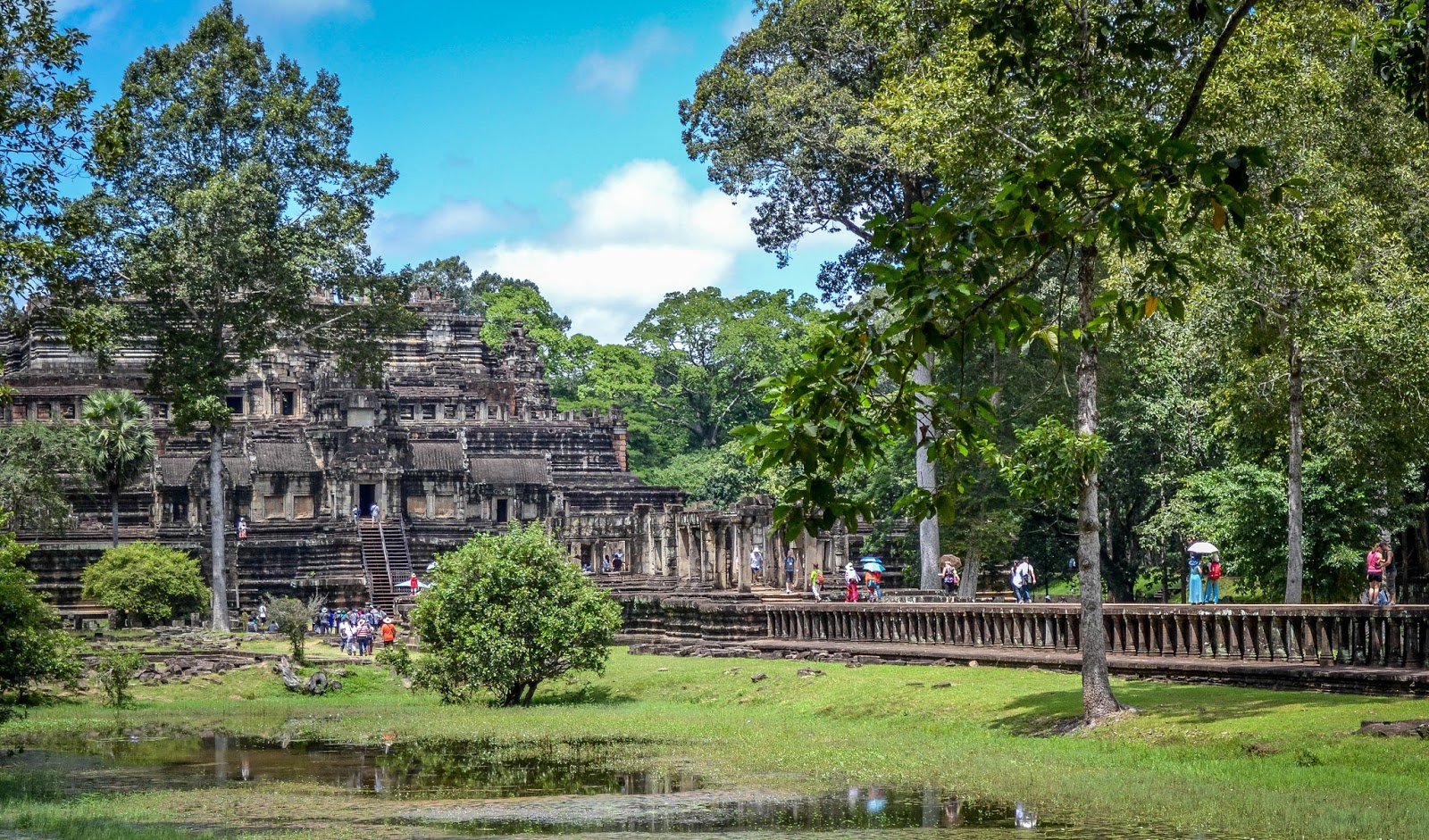
The Temple of Baphuon at Angkor Thom
An example of a pyramid style, Hindu temple, later converted to Buddhist and subsequently neglected requiring extensive demolition, new foundations and reconstruction stone by stone.


Bauphon temple; dizzying size and scale

The Terrace of the Elephants; wall detail showing elephants and riders


The Temple of Bayon at Angkor Thom
The last temple to be built at Angkor, also in the pyramid style, originally a Buddhist temple, converted to Hindu, reverted to Buddhist and finally abandoned to the jungle for centuries.


The shade of the ruins provides relief from the afternoon heat


A total of 216 stone faces look down from the towers with serenity at people passing by

 
Siem Reap
The previously unknown nearby village of Siem Reap mushroomed quickly from the global interest in Angkor such that it now serves the needs of tourists coming from far and wide to while away the hours, unwind under the trees and wander through the temple ruins at their own leisure.

Although most visitors only stay for a few days or perhaps a week at most, the ancient city of Angkor offers enough temple ruins to keep a person busy for months.  That's even without digressing to the mangroves of the great Tonle Sap lake, river cruises or other tourist attractions.  Whichever brand of spiritualism you succumb to there is a tangible feeling of peace and tranquility to be absorbed from these ruins which is curiously not present when ambling around other hallowed loci such as the Vatican, the Temple of  Karnak, Bangkok's Temple of the Emerald Buddha, Ephesus' House of the Virgin Mary, Turkey's Mount Nemrut or the Hagia Sophia.  Whether this is due to the natural jungle setting or the magnificent size, scale and geometry of the structures, the colours of the rock, the intense hue of the sunlight or the play of the shadows is impossible to say.  The overall impression that one takes away from the place is one of quiet, contented, calm, confidence, energy and optimism.  The ideal place to get away from it all.


Monday, 29 January 2018

Creeping Entitlement in The Land of Fawning Charm

There are some things which are known with absolute certainty - without even the shadow of a doubt. Umbrellas are a fine example. It is an immutable law of the cosmos that if you venture outside with an umbrella, then it probably will not rain. On the other hand, if you step out with no umbrella, you will definitely be soaked in a deluge of near-biblical proportions.

The Avengers; Emma Peel and John Steed - never caught without an umbrella

Curiously the one thing people always carry everywhere is not an umbrella, but rather a bottle of water. Millions of people buy zillions of bottles every day despite no intention of going to a desert, a canyon or into near-earth orbit.

Even allowing for those exceptional raves where you wake up handcuffed naked in a barn or locked in the trunk with a palpitating sheep, actually suffering from thirst in the built environment is highly unusual. The most unusual might be the unfortunate case of hygiene inspector Huckleberry who fell into an open water tank in a Lincoln lemonade factory in May 1925 only to be discovered dead of thirst 10 days later. As the coroner dryly observed; it was ironic that Huckleberry fell into the tank with his umbrella, for had he not, it would undoubtedly have rained several times, allowing Huckleberry to survive by drinking the rainwater until he was rescued.

In Korea, the immutable law of the cosmos is that your status gives you 'entitlement without reproach', whether you drunkenly slander the entire nation or you get caught with your grubby little paws in the national coffers. Entitlement works on many levels. Within a relationship, the one who earns the money (or whose parents bought the property) holds the entitlement. Within a family, additional entitlement comes with seniority; older siblings hold more sway than younger siblings. Within a company, entitlement comes with job title plus whatever dirty secrets you know about those above you. Within politics, entitlement comes with all this plus your family's connections.

Japan is known as the 'Land of the Rising Sun'. Korea similarly styles itself as the 'Land of Morning Calm'. This is often caricatured as 'The Land of Fawning Charm' by politicians and businessmen who are simply unprepared for the overwhelming barrage of politeness and humility launched by Koreans when meeting them for the first time. Such behaviour is steeply rooted in medieval Confucianism.


Confucianism in Korea flourished from 1400 onwards

Confucius idealised a strict social hierarchy in which each person shows respect to those of a higher station and treats those of a lower station in the same way the person would wish to be treated themselves. Today this Confucian legacy still very much applies upwards; charming one's betters has been perfected to an art form. However while Koreans display the utmost deference to those above them, they often display the striking indifference to those below them. Showing grace to the lower orders is giving way to a creeping sense of entitlement to treat them with contempt.


Example 1: Too much candour


Mr Na: 'tired and emotional'
In 2016, Mr Hyang-Wook Na, a 'high-ranking' head of the Education Ministry's policy unit claimed that 99% of South Koreans had no ability to move up in the world and can be treated like dogs and pigs - simply fed and kept alive. Furthermore, he proposed that South Korea should better consolidate its class system because people are not born equal.

 http://www.latimes.com/world/asia/la-fg-south-korea-dog-pig-20160711-snap-story.html

The public outcry was furious, the Education Ministry quickly suspended Mr Na, the Education Minister himself apologised to the public personally for Mr Na's 'misunderstood comments' and for a few days it looked like Mr Na might actually lose his tenure. However, as proof that Mr Na was sufficiently 'high-ranking' to be entitled to such opinions, he sued the Ministry for wrongful dismissal and won his job back.

http://m.koreatimes.co.kr/phone/news/view.jsp?req_newsidx=237212

The time-honoured get-out-of-jail-free card of having over-imbibed was successful as ever, as was the sympathy angle that loss of his job, severance pay and retirement package was entirely disproportionate to the offense caused to Korea's great unwashed and the shame brought on the Education Ministry. Mr Na's reinstatement clearly confirmed that the bottom-feeding riff-raff in the lower orders of Korean society should learn to accept being viewed and valued this way by their government.


Example 2: The No-look pass

Political lawmakers evidently feel even more entitled to belittle their peasants than mere policy gurus. In May 2017, lawmaker Moon-Sung Kim of the minority conservative Bareun Party passed through the airport arrival gates and casually chucked his luggage to his humble, kowtowing manservant without a greeting, nod, thanks or any other acknowledgement of the poor wretch's pitiful existence.


Kim's ingrained indifference was immediately seized upon by waiting press who had a field day with the images. Picking up on a basketball analogy, his luggage-lobbing manoeuvre became known as the "no-look pass".

http://www.koreaherald.com/view.php?ud=20170615000596

However, true to form, Kim underscored his entitlement to treat employees as serfs by simply stating that the media should mind it's own business and report something important.

http://www.koreaherald.com/view.php?ud=20170524000862


Example 3: Off-road Rage

Many companies proudly subscribe to the principle that the customer is always right. Simple. Black-and-white. However things become instantly more colourful when the customer takes this view himself - and takes it seriously. Mr JeHa Yu for example leased a US $ 250,000 Mercedes and returned it for diagnosis after the engine conked out at high speed. When the problem reoccurred Mr Yoo demanded the car be replaced if it happened a third time. When it did occur a third time and the dealership stalled over replacing his car, Mr Yu used a baseball bat and golf clubs to destroy the car publically.


http://www.businesskorea.co.kr/english/news/industry/12079-reaction-man-beats-own-mercedes-golf-club-front-dealership

We do not know if Mr Yu's lease allowed him a repair, a refund or a new car. Certainly the decision was way beyond the experience and pay grade of the dealership staff. Mr Yu could have taken legal advice but ultimately (in a wild departure from Confucian wisdom) he convinced himself that he was entitled to vent his anger via mindless vandalism.

Mercedes later acknowledged a fault in the engine management chipset of a number of cars and dutifully recalled them. Mr Yu is presumably still very busy with his lawyers.


http://english.chosun.com/m/svc/article.html?contid=2015111601755&Dep0=www.google.co.kr


Example 4: Nut Rage

In 2016 after boarding a Korean Air flight from New York to Seoul, Heather Cho was served macadamia nuts in a packet, not a tray, which is an horrifically distressing burden for a first class passenger. As daughter of the airline's CEO and owner she then made herself internationally infamous by becoming so enraged she forced the plane to turn around on the tarmac and return to the departure gate to eject the head steward for not knowing his job.

Global media mused whether forcing a plane to deviate from its flight plan may technically qualify as a hijacking. Meanwhile domestic media wrote this up as yet another immature spawn of an industry mogul abusing their status by intimidating employees.  


Heather Cho: a very public scandal
Under a mop of long hair Ms Cho ate humble pie before the cameras, apologising for her behaviour and the inconvenience she caused to other passengers. Very little was said about how she treated the airline staff; a discussion which was quickly buried as if irrrelevant.

Excruciatingly it took until this year for a panel to convince itself that seizing control of the aircraft while still on the ground absolved Ms Cho of hijacking and that her sentence could be both reduced and suspended. It never hurts to be well connected. And just to show that there is no shortage of redemption at the top of the food chain, Heather and her father now get to surpass tens of thousands of common ilk applying to become torchbearers for the 2018 Winter Olympics.


http://m.theinvestor.co.kr/view.php?ud=20180125000813


Example 5: The Sound of Silence - at a high price

High-rise towers of 25 to 45 floors dominate the skyline of all Korean cities. 


Moving Out - with the help of ingenious telescoping booms

While Koreans have devised all sorts of ingenious telescoping lifts to get furniture in and out of their apartments, other tasks such as window cleaning and external painting are still done by teams abseiling at the end of long ropes. 


Old technology: cleaning windows
Work hours are long, refreshment options are limited and the weather can be punishing but lively chat amongst the team and a little music help to make a thankless task bearable. 

Last summer, one resident took exception to the music of one such painter, then promptly went up to the roof where he simply cut through the painter's rope. The 40 year old father of 5 fell 40m, hitting the ground at ~65 mph.
The aggrieved resident did not initially own up to cutting the rope but was soon identified by police to whom he casually offered the excuse that he was drunk having failed to get a job and didn't like the painter's music.


Featured post

Just When You Thought it's All Over ...

Let's face it; some men are naturally gorgeous. They are mouth-watering, perhaps even scrumptious; whether they have just been pulled o...