Saturday, 27 August 2016

I don't believe in Peter Pan, Frankenstein or Superman

One thing which guarantees that travel never gets boring is that the people you meet will always be at least slightly 'different' to anyone that you ever met before. Different means not only varied but sometimes quite odd and just occasionally, a tad spooky. Once on a train from Vienna to Paris, a chap briefly introduced himself before enthusing passionately about how lucky the British were to have Mrs Thatcher as their Prime Minister. Mrs T was admittedly at the zenith of her career so many subscribed to his point of view, although perhaps less of them feel the same now. When I asked what it was specifically about her that he admired so much, he said it was for her great leadership skills and the endless time she devoted to help less able governments solve their problems on other planets.

[Yes I'll pause here just so you can read that again.
My neurons also had trouble processing these signals]

If I hadn't been paying full attention up to this point, then I certainly did from that moment onward. Thinking that something was slightly amiss, I casually hugged my personal possessions a little closer before asking the chap to clarify a little further. He took this as an open invitation to describe the great difficulties that people have on other worlds, trying to live peacefully but in a constant state of conflict, under weak governments that were unable to help their citizens due to corrupt politicians and the threat of strong militaries. He observed sagely how problems were much the same everywhere that you look in the universe. How great it was therefore, that Mrs T could spare the time from her own busy schedule to consult with our galactic neighbours, to manage their crises and to guide them through their problems. 
While his belief in his idol suggested that fragments of this chap had already slipped into another dimension, in most respects his feet remained firmly based in our reality. For example he was fully aware that any galactic neighbours would be so far away that Mrs T couldn't actually go to these worlds to help in person; the best she could do was to advise long distance. In other words he may have blown one cylinder but he was getting along quite well firing on the other five.


One way in which people certainly differ is the way that they relate to sport. Some cheer from a safe distance, others get sweaty together in a team while a few indulge alone for a little reflection or self testing. Similarly, while some only dabble occasionally, others have regular fixtures while a few show a near religious devotion. In Korea cycling and hiking are far and away the preferred opiates of the masses and virtually everyone is hooked.

Despite its rugged, mountainous terrain, South Korea already benefits from almost 2,000 km of dedicated cycle lanes across the length and breadth of the country. Those along Seoul's River Han are extremely popular with people of all ages. 

http://english.visitkorea.or.kr/enu/ATR/SI_EN_3_6.jsp?cid=1898731

South Korea: paradise for cyclists  

The phenomenal popularity of the sport is undoubtedly due to the supporting infrastructure which goes well beyond a simple cycle path and an occasional bench.  At regular intervals there are 7-Elevens, coffee shops, bike shops, hire and repair stations, cleaned and maintained washrooms, outdoor gyms, courts for playing tennis, badminton and basketball. Everything is set up at regular intervals along the routes so that no matter what happens, you're never more than 10 minutes away from a helpful pit-stop, car park, bus stop or train station.  There are even elevators to cycle over-bridges and stairs with ramps to link the cycle routes together over the main auto routes.


Need to cross the highway ?
Use the cycle elevator or the stairs with cycle gutter rail

A quick glimpse at the global bicycle market reveals the following;


"You say Rolls I say Royce
You say God give me a choice
You say Lord I say Christ
I don't believe in Peter Pan, Frankenstein or Superman
All I wanna do is Bicycle..."

The video to Queen's 1978 single Bicycle Race featured 65 naked models.
Subsequently the video was either censored or banned outright in many countries worldwide.
As much fun as this must have been, it still didn't do for cycling what South Korea has done today.


Topless cyclists join Freddie on stage at Madison Square Gardens in Nov 1978.
Worldwide it did wonders for the sale of Queen albums, leather pants and thongs but precious little for bicycles

Perhaps uniquely in Korea there is no concept for 'entry level'; if you're into something, it's all-consuming.  Whether cycling alone, in pairs, in families or in teams, the cycling equipment itself is nothing short of top notch. It's not unlikely that the bike wheels alone set the owner back US$4,000 and the rest of the bike maybe 3 to 5 times as much. The whole thing together may weigh little more than 6kg and is so sleek that it is near-invisible when viewed from in front or behind. 

Equally there is no entry level for the rider's outfit, kit and accessories. No self respecting cyclist wears tennis shoes, basketball shorts, a football shirt, a skating helmet, or driving gloves. Cycling demands only the latest high-living, ever-giving, cool-fizzing, cycle-whizzing sportswear; the costs of which will certainly make your eyes water unless, of course, you're wearing your dedicated cycling sun shades ;)


All or nothing: if you're going to do something, do it right

The last generation could spend a year's salary on a new car. This generation can spend the same on a new bicycle.


Thursday, 11 August 2016

The Dog Days of Summer

Endurance tests have long since become a cheap distraction with any number of increasingly tacky formats competing to see how long a person can sit on a block of ice, lie in a box of snakes or eat hot chilies before they give up, sit up or throw up. Mostly these trials are conjured up by reality TV for willing participants who are paid handsome fees according to their perceived entertainment value. However, back in real life some of us are annually subjected to impossibly cruel endurance tests, against our will with absolutely no chance of surrender, escape or relief. In Seoul, the worst of these tests is undoubtedly the Dog Days of Summer.

The Dog Days are generally the hottest, most humid and oppressive days of summer. The exact timing of the days drifts slightly from year to year, but begin with the rising of Sirius, the Dog Star, just before sunrise in late July or early August. 


Sirus the Dog Star (right) rising just before sunrise: this marks the start of the Dog Days of summer

In many western cultures the Dog Days used to mark an ominous period of summer fevers and/or languid apathy. In ancient Egypt they indicated the onset of the flooding of the Nile.  In Korea the Dog Days mark the warmest 30 days of the summer; starting 13 July and ending 12 August (in 2016). For farmers this is the peak of the growing season but for unfortunate city dwellers this is about as close to a vacation in flaming Hell that anyone wants to experience in this lifetime (or the next !).


Summer in the city -
 During the Dog Days, water is a must


Empirical measurements of temperature and humidity don't even begin to convey the tedium of the Dog Days in the city. Maximum daytime temperatures may hit 35'C/95'F with humidity exceeding 85%. Overnight minima may not fall much below 28'C/82'F with humidity touching 95%. However, what makes these suffocating conditions acutely testing is the near total lack of wind together with a day-after-day failure to provide even the briefest relief by virtue of a short shower or an occasional cloud.  This despite the humidity being almost high enough to be able to lick the moisture directly from the very air itself. As difficult, oppressive and fatiguing as these conditions become, they would be nothing special without adding a few crafty Korean twists to the misery.


It is about this time of year that some bright sparkie typically discovers something that should have been realised about 10 years earlier.  For example in May 2013 it was revealed that that the quality certificates for safety-critical cabling on 2 of the nation's nuclear power stations were faked. 


http://www.bloomberg.com/news/articles/2013-06-03/south-korea-issues-power-shortage-warning-amid-nuclear-stoppages

The incident rapidly spiraled into a total public relations meltdown as detailed investigation showed that the owner of the power station (Korean Energy and Power Company, KEPCO) actually colluded with suppliers to fake the quality certificates.

http://m.hankyung.com/apps/english.view?aid=201608121025281&category=


The Dog Days of 2013: unprecedented power shortages as a result of forged quality certificates


Orders were immediately given to shut down the affected reactors just two months before the start of the Dog Days. These unexpected shutdowns were not compensated by delaying the outage of any other power plants, so basically 2 weeks before the Dog Days, the country was already using about as much power as it could generate. In the head office of KEPCO, the display above the front desk showed that the country's grid was on the brink of collapse; power consumption was already 96.5% of the maximum available power generation.

Against this background, the govt issued emergency orders to reduce power consumption. Manufacturing production was staggered throughout the day to smooth out the peaks in demand. Escalators were rationed to operate during peak hours only. Meanwhile all government, corporate and retail premises were ordered to reset their air conditioning to only operate when temperatures exceeded 26'C/79'F.  Such premises included most places where people usually seek refuge from the scorching heat, including the subway systems, the shopping malls and offices. Of course, to show the nation how hardened its employees already are to hardship and sacrifice, Samsung execs directed that its thermostats would be reset to activate the aircon only above 28'C/82'F (see the above link to Bloomberg's article).  The Korean battle-cry of "Fighting !" was politely stifled around the offices as middle management hurriedly put their hands in their pockets to finance armfuls of ice lollies to prevent their teams from lapsing into comas.   


And so began 6 of the longest, least hygienic, most punishing weeks of life in the city. Each day hordes of hapless office dwellers were condemned to faithfully report to work, just to sit and experience what happens to a casserole when it is put in a slow cooker for 10 hours. By 10 in the morning people's socks were already squelching in their shoes.  By noon people were sitting in puddles of their own juices, pooled in the fabric of the seats of their chairs.  By 4pm the sweat was actually rolling off the back of their eyeballs and draining freely out through their ear canals as they desperately held the front of their shirt open in front of 4 feeble desk fans running full throttle from the USB ports of their laptops. Whatever this was, it sure wasn't civilisation.


Dog Days in the city - you wouldn't wish it on your best friend or your worst enemy !

The cynic'c post script to this episode is that the most valuable lesson learned from the 2013 debacle may not be that quality certificates should not be faked.  Rather the operators of government, corporate and retail premises learned how much they could reduce their electricity costs by rationing the use of escalators and air conditioning. Subsequently, since the Dog Days of 2013, despite no further critical power shortages, a more responsible use of power seems to have taken hold. Selected subway escalators still only operate in peak hours while the ambient temperatures in most large buildings are now sensibly higher than the super-cooled days before 2013. 


Wednesday, 10 August 2016

The Eternal Victim


While a strong sense of national pride can be found in many corners of the globe, there are few countries in which that pride is firmly rooted in the endless suffering of its citizens. Of course the worst kind of suffering comes from being a victim of others and so endless suffering means being the eternal victim. Far and away the world's most accomplished actors in the role of The Eternal Victim can be found in Korea. Whether it is historical victimisation by evil colonists, present victimisation by an upstart neighbour or being the future victim of a rapidly dwindling population, no opportunity is missed to don the mask of The Eternal Victim and then hobble feebly around the international stage reminding the world of their timeless, unjust suffering.

Politicians, the media and academics alike routinely exploit every opportunity to remind the nation that South Korea is, once again, the blameless victim of yet another injustice. As a former 'protectorate' of Japan, Korea was not only the victim of brutal Japanese colonialism but is still subject to Japanese imperialist claims over the disputed Dokdo/Takeshima Islands. 


The Dokdo/Takeshima Islands (also Liancourt Rocks)
46 acres of international tension

 As a neighbour of North Korea, South Korea is constantly being harassed by Kim Jong-Un, the 'Comrade of the North'. But of course it doesn't stop there; beyond North Korea there is a 'darkly conspiratorial China', 'deliberately refusing' to reign in North Korea so China may take advantage of the instability on the peninsula. Then there's any number of daily injustices reported in the media, including;


Since Japan has driven down the value ot the Yen,
Psy is reportedly the only Korean export to buck the trend of slowing growth of Korean GDP


Curiously the media has not yet proffered a boffin to explain how these dangerously high levels of 'foreign pollution' concentrate in a cloud over the centre of Seoul while the rest of the country remains relatively unpolluted.  No doubt the first person to do this will become a national hero.


Air quality indices across South Korea on 10 Aug 2016.
Red indicators in and around Seoul show dangerously unhealthy concentrations of PM2.5 particles.
Pollution in the surrounding countryside are low by comparison 


Since the Korean war ended in 1953 and the emergence of two separate Koreas instead of one, South Korea took on the persona of the smallest kid in the playground; the one who is misunderstood, is especially vulnerable, has no friends to speak of and is regularly victimised by all the other kids in the neighbourhood. Fortunately the biggest kid in the playground flexed its muscles, pledged its unswerving support and so for decades the US has maintained a fully equipped deterrant of approx 30,000 troops in South Korea. The annual US/South Korean military drills on land, at sea and in the air are a regular show of that commitment. 

Observers might have hoped that with the huge clout of friends like the US, South Korea would have used its boosted international status to move past the mistakes of the colonial era, to bury the greivances of WW2, to mend fences and build new bridges with its neighbours and go on to take a leadership role in an economic community of south Asian powerhouses, through which to promote trade, prosperity and stability of the entire region. This would not be an unreasonable achievement for a hard-working, rapidly industrialising, wealthy nation with a little vision and firm US backing. Sadly, the inability to let the dust settle on the events of WW2 (which ended 70 years ago) and the penchance to mewl constantly about the injustice of it all to anyone who will listen, ultimately prove to be the defining characteristics of what could have been the most highly achieving nation of the modern era. 

Instead the smallest kid in the playground remains content to stand on the shoulders of the largest kid, from where it simply thumbs its nose at its neighbours and paints them all as the bad guys. While the little kid enjoys the comfort and security of an unassailable ally, he fails entirely to win any credibility or respect for himself in the playground. His neighbours look forward to the day then the biggest kid moves on, at which point the smallest kid will wish that he had made more friends when he had the chance. 


President Trump: Things that make you go; "Hmmm......"


Wednesday, 20 July 2016

Newsflash #1: Seoul slams North Korean missile test reports

Life on the Korean peninsular entered a new era of wailing and gnashing of teeth this week as millions of South Koreans collectively deplored reports that North Korea has test-fired ballistic missiles into the sea. Howls of protest and outrage could be heard all the way from Seoul to Beijing as an alarmed South Korean public demanded to know why these missile tests had been so inaccurately reported and most importantly; who could be blamed for this diabolical conspiracy to undermine South Korea's global standing ?

North Korea test-fires ballistic missiles 500km into open sea - but which sea ?

United Nations Secretary General Mr Han So-Lo confirmed that on Tuesday July 19th, North Korea launched 3 ballistic missiles into a clear area of open water approximately 500km off the east coast of North Korea. Mr Han complained; “These missile launches were followed by frenzied, inaccurate and totally irresponsible reports by the international media that North Korea had fired ballistic missiles into the “Sea of Japan”. This is unacceptable, do you hear, me ? Totally unacceptable !”. 

Mr Han was clearly very tired and emotional, as evidenced by his occasional lifting of one eye-brow higher than the other, a perceptible half octave elevation in the pronunciation of his adjectives and twelve small green bottles sitting empty on the wall behind him. He continued by imploring the international community for more responsibility and restraint in its reporting of these events.


Correct reporting: missiles fired into "The East Sea";
http://english.chosun.com/site/data/html_dir/2016/07/20/2016072000730.html


Incorrect reporting: missiles fired into the "Sea of Japan";
http://www.independent.co.uk/news/world/asia/north-korea-ballistic-missiles-launched-sea-of-japan-south-korea-a7143816.html


http://www.abc.net.au/news/2016-07-19/north-korea-fires-series-of-missiles-towards-sea-of-japan/7640358


Mr Han opined; 
“For the last 2 decades, South Korea has worked tirelessly and lobbied relentlessly on every continent and through literally scores of national and international pressure groups for the sea east of Korea to be re-named “The East Sea” . This is a key demonstration of our global resolve to bury all references to Japanese Imperialism and it has absolutely nothing to do with trying to belittle Japan on the international stage (honestly). 

"Admittedly we were initially discouraged when most organisations simply dismissed our campaign out of hand. They conveniently claimed that they had no jurisdiction to change a name which has been established multilaterally on charts, maps and navigation almanacs for centuries already. But as recently as 2014 we finally had our first breakthrough ! After also rejecting the idea at first, Virginia’s House of Delegates finally agreed to make it legally binding to show “The East Sea” as an alternative name to the “Sea of Japan” in all their approved state schoolbooks. 

"How reckless therefore, that these first small shoots of progress on this issue should be effectively obliterated by this week's totally inconsiderate global media reports. This has cruelly trampled all over South Korea’s hard-fought, hard-won hard work by thoughtlessly perpetuating the use of this imperious reference - and for what ?  Just to highlight some extravagant new fishing techniques being tested by Kim Jong-Un and his Pyongyang cronies in North Korea. 

"This callous reporting has set back our "East Sea" campaign years, decades even. It is shocking and outrageous and as such, totally unacceptable.” repeated Mr Han. 

At the end of a clearly impassioned speech Mr Han finally invited reporters to ask questions.  A representative of The Tokyo Times asked humbly if, given the outstanding success in Virginia, South Korea would now begin campaigning to change the "East China Sea" into "The South Sea". At this point Mr Han sat down sharply (on his assistant) and refused any more questions.

Mr Han warned that from this day onwards, South Korea demands sincere apologies from everyone, everywhere.  Also he demanded immediate assurances that all references to “The Sea of Japan” shall be deleted and that this mis-nomer shall never be used by anyone, ever again. Ever.

Ever wonder why you're alone in the world ?
The one common factor in all of your failed relationships is you ;)

Saturday, 9 July 2016

Seoul Survival Skills: #1 The Poker Face

Anyone who enjoys their stand up comedy delivered dry like a vodka martini can appreciate the rare pleasure of an hour or so in the audience listening to Mr Jack Dee. His humour is as biting as his delivery appears effortless as he offers new perspectives on everyday events which you normally barely notice.

One evening at the Corn Exchange in Cambridge Mr Dee announced his great fortune at having taken delivery of his first baby some months earlier.  Said baby was incredibly strong, amazingly agile, inquisitive about everything within arm's reach, highly observant and a well-practiced mimic.  Mr Dee confided that in fact the whole parenting experience exposed him to an entirely new range of emotions which he had never believed possible; thoughts which he had never had before, and all so powerful that they defied his ability to put them into words. Dee reassured the audience with his trademark, dead-pan, poker face, that in all seriousness, there is no dictionary in any language anywhere which contains the vocabulary required to describe the thoughts, emotions and sheer disbelief which wracked every fibre of his being when he bent down to press the eject button on his VCR and out popped ..... a piece of cake !

There can be few places where poker face skills are more important to survival than Korea. Meals are just one of the many social arenas where one needs to be ready for just about anything which tests one's fight or flight reflex. Just for starters, take the everyday example of the innocuous oxtail soup.


Oxtail soup: this is what you thought you ordered.
You've had it at home every week since you were in diapers.


Oxtail soup: this is what they prepared in the kitchen.
The tail of the wretched animal flayed of its hide and sliced into its individual vertebrae.


Oxtail soup: this is what arrives at the table.
Each vertebra to be picked up with chopsticks and the meat to be sucked off with the lips.

Under these testing conditions, one must remember the basics;

  • image is everything; in this case, maintain the illusion of mild-mannered, unflappable cool at all costs. Pretend not to have noticed that the soup was even served 
  • cause no offence;
    remember that to be offended by the food is to offend the host and their choice
  • express wonder, excitement and gratitude at the sheer novelty of the experience;
    Jean Giraudoux, George Burns and Alan Shore each agree that once we learn to fake sincerity then there is no end to what we can achieve.  Although such skill may admittedly be wasted on a mere lunch, consider it practice for the next inevitable emergency.

The next emergency may well occur at dinner with the time-honoured favourite Knee Bone Soup (Seolleongtang), containing the complete knee parts of the unfortunate animal whose tail provided such a challenging lunch.


Knee Bone soup: comes complete with bone, cartilage, gristle and all those other things that you relish for dinner 


Although such traditional recipes are still very much a firm favourite with the older generation, these days some younger Koreans are starting to politely decline them in preference for something more appetising.

It is worth highlighting that the modern Korean diet is in fact a very healthy one; being focused on fresh meat and vegetables rather than lots of processed food and carbohydrates.  In common with much of Asia, seafood and seaweeds still form a larger proportion of the regular diet than in most western countries.  Live seafood restaurants are found everywhere, proudly displaying their fare in rows of large tanks in the front window to tempt hungry pedestrians.


Seafood and eat it, don't walk on by
However, even here one still needs to be prepared to maintain the well-practiced poker face if the food delivered to the table doesn't quite match expectations.


"Waiter, waiter, there's an octopus in my soup !"
Health warning: unverified anecdotes claim that the suckers often remain functional after cooking and can attach themselves to the inside of the esophagus if not chewed completely before swallowing.
  

Of course cooked octopus will immediately disappoint any Klingons who happen to be passing through this star sector. Therefore for those who prefer their food not only fresh and raw but actually wriggling, live octopus is just one service on offer.
(warning: not for the faint-hearted or for octophiles)


You flinched !  I saw you !


Thursday, 23 June 2016

The Times They Are a-Changin'

A little over 2 decades ago I came to, very slowly, in an increasingly familiar fuzzy stupor. I was in a darkened hotel room in Seoul with a woman who promised she could “Get you out of the sack with more of a kick than even the strongest mug of coffee”. The night before had finished at 3am when the soju had mercifully run out. It was now the unholy hour of 06:15 and the woman in question was 'The Caffeine Queen' broadcasting over the American Forces Network, Eagle FM. It was her mission to chase some 37,000 US troops out of their cots every morning and drive them punctually via the showers into the mess. To prove how adept she was at this, she sequenced 'You Oughta Know' by the rapidly charting Alanis Morissette followed relentlessly by Rainbow, Aerosmith and Meat Loaf - clearly she was leaving no man behind. As for me, stumbling into the hotel bathroom provided no refuge; the radio was piped in there too ! As I sidled gingerly under the cool water The Caffeine Queen asked her listeners coyly if they knew the difference between a hotel room and a white BMW ? She confessed that actually she didn't know, but evidently neither did Hugh Grant until two of LA's finest stopped to explain it to him, personally, at length, in painstaking detail. 

Having just pocketed a 'mere $100k' from an endearing signature performance in Four Weddings and a Funeral, Grant was on track to command a more respectable $6m for his next movie before being busted for a 'lewd act' in a car with Divine Marie Brown. LA police were alerted by the rear brake lights of Grant's parked car which lit up repeatedly and with a certain rhythm. In the media frenzy which followed, Grant's fee for FWAAF positively wilted under The Sun's scorching offer of a 'mere $150k' to Ms Brown to tell all. Indeed one film producer pondered seriously if Grant had possibly jeopardised his whole career; observing wryly that "Sean Penn could get away with this. But not Hugh Grant". 


Him: "I've always had a crush on cheerleaders. Catholic cheerleaders—my double favorite,"

 Given Grant's close-but-not-exclusive relationship with the peerless Ms Hurley, the story immediately gained a life of its own. It showed that even without the internet, even in parts of the world without radio, places which still relied on carrier pigeons, smoke signals or tea leaves, news like this was never going to remain secret.


Hurley: "Really ?  I mean.... R-E-A-L-L-Y ?"

For those of us who were not trying to b
ail out a film career by elevating the miserable apology into a new British art form, the real world was really picking up the pace and nowhere more so than South Korea.  

Since the 1990's Seoul is regularly referred to as The Miracle on the Han River in reference to the speed and size of it's growth and prosperity since the 1970's. Currently it is home to an astonishing 50% of the country’s population of 50 million, making it the world’s fifth largest megacity, behind Tokyo, Jakarta, Delhi and Manila in that order. 


Identical views of Seoul in 1929 and 2009 -
documenting phenomenal development, most notably from the 1970's onwards

In 1979 the most expensive office building was the Daewoo Building in central Seoul, directly opposite Seoul Railway Station. The building is 
118m tall and for almost 20 years the chairman of the mighty Daewoo chaebol ruled his empire from the top floor, making the building a monument to the new-found economic success of Daewoo and South Korea in general.  Sadly Daewoo imploded in the 1997-1998 financial crisis, after which the building languished until 2006 when it was ill-advisedly bought by Morgan Stanley as part of its global real-estate portfolio.  Only 4 years later the building became infamous as the centrepiece of the largest ever loss in real-estate private equity funds as Morgan Stanley booked an exceptional write down of 60% on the protfolio.

  
http://www.koreatimes.co.kr/www/news/biz/2010/04/123_64829.html

In time-honoured tradition the famous folly was rapidly renamed 'Seoul Square' and today it houses the regional headquarters of various global conglomerates including Siemens and Mercedes Benz, as well as the German and Chinese embassies.

Happy Days: a light mural on the facade of Seoul Square.
The new face of the old seat of the Daewoo Empire.

By 1985 the title of Seoul's tallest structure passed to 'The 63 Building'. Standing 250m high it was double the height of the Daewoo Building and was the tallest building outside of North America at the time.  Built on the south bank of the river, it signaled that the centre of finance and wealth was moving out from Seoul's old city centre and across the river.


Seoul's 63 Building; at 250m, still the world's tallest gold clad building since 1985

This is not to say that the Miracle on the Han River has gone without some painful hitches.  Early one morning in Oct 1994 one deck of the Seongsu Bridge fell into the river without warning. The bridge was only 15 years old. Amazingly there were only 32 fatalities, although many  of these were schoolchildren.

http://www.nytimes.com/1994/10/22/world/32-reported-dead-as-bridge-collapses-in-seoul.html?scp=1&sq=++seoul&st=nyt


The builder of the bridge, the Dong Ah Construction Industrial Company, appears to have cut corners on welding to finish the bridge quickly, the Korean Society of Civil Engineers said

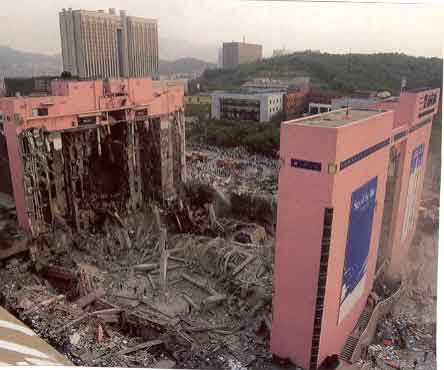
However this incident was totally eclipsed less than a year later when the Sampoong Dept store collapsed in June 1995 with 500 deaths and almost 1,000 injured.

https://www.theguardian.com/cities/2015/may/27/seoul-sampoong-department-store-disaster-history-cities-50-buildings


The Sampoong Dept store collapse in June 1995:
The most fatalities in a building collapse until New York  9/11 2001

Today the citizens of Seoul are waiting for the grand opening of the city's next great landmark; the Lotte World Tower.  Its 123 floors and 555m height make it the tallest building in the OECD - for the moment.

http://www.nytimes.com/2015/07/15/realestate/commercial/in-seoul-lotte-world-tower-rises-leery-koreans-watch.html?_r=0

The Lotte World Tower was topped out in Dec 2015:
a reminder of the distinguished legacy of the founder of the Lotte chaebol.

Note the relentless spread of normal high rise over the hills and far away.

The founder of the Lotte chaebol is Mr Shin Kyuk-ho, already in his 90's.  So important is the completion of this project and so subtle is the influence of Lotte that a military runway was realigned so that construction of the tower could go ahead.

Curiously not everyone is convinced of the distinguished legacy of the Lotte founder.  The chaebol now finds itself at the centre of an unprecedented investigation of its business affairs and has responded by hiring five of the country's top law firms to defend it.

http://m.koreaherald.com/view.php?ud=20160617000708&ntn=0

http://m.koreatimes.co.kr/phone/news/view.jsp?req_newsidx=184170


No doubt there's more to this story to follow later ;)


Sunday, 19 June 2016

"The Price of Everything and the Value of Nothing"

In Lady Windemere's Fan (1892) Oscar Wilde's Lord Darlington famously defined a cynic as a man "who knows the price of everything and the value of nothing".  Pedantically it may have been more accurate to define this cynic as the man "who knows the cost of everything and the value of nothing". The intended criticism being that it can often be shallow or shortsighted to assess a thing based on its cost rather than the value of having it.  However a century later our global economies are still, self-evidently based on the (perhaps, super-cynical) ability to look for every possible opportunity to maximise the difference between the cost and the value of an item; obtaining it at the lowest possible cost, maximising its value and selling it for the highest possible price.  For most of what we buy the price of a thing is so finely tuned to its perceived value that the cost is rarely even considered.

Physical assets such as property, cars and jewelry as well as less tangible commodities such as health, education and career development are priced in terms of their value perceived by the consumer rather than the cost of actually providing them. Property is valued by demand, not by the cost of construction.  Cars are valued by speed and luxury, even though traffic jams make the former redundant and perhaps only the latter really relevant.  Gems are valued by their rarity which is itself manipulated by hoarding vast stockpiles to artificially restrict supply.  Similarly the prices of private health, education and career development reflect perceived value rather than cost.  Such is the world we have created.

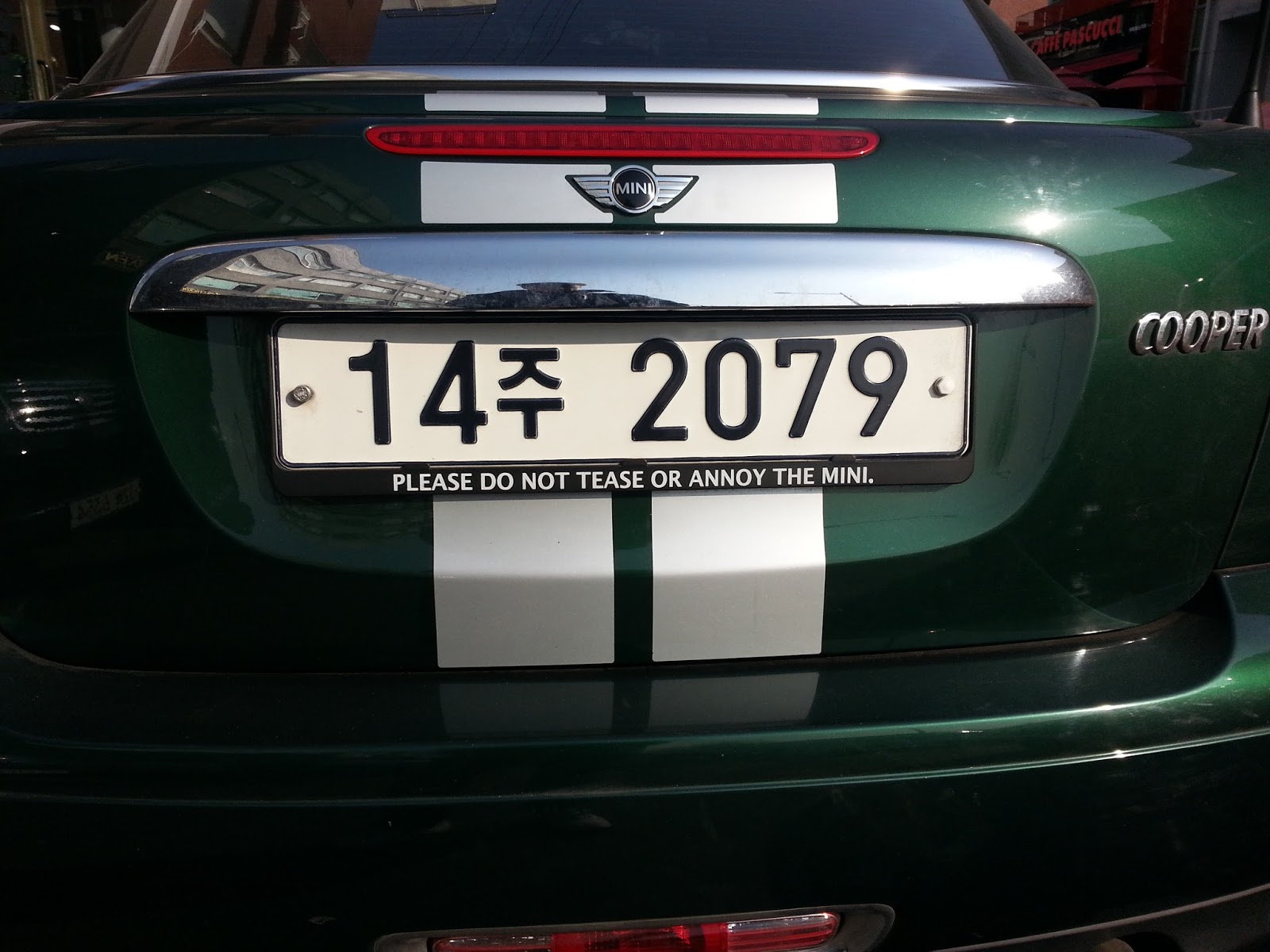
In many ways Korea is a soft target, perhaps even a willing victim, of the global advertising and marketing strategies used to hype the perceived value of international products.  It is nothing short of bewildering that Korean cars such as Kia are regularly voted 'International Car of the Year' but Korean consumers are desperate to pay eye-watering premiums for foreign cars which are usually not as good as the cheaper domestic products.

https://en.wikipedia.org/wiki/Car_of_the_Year

Laurence Fishburne as Morpheus from The Matrix, promotes Kia's K9 at the 2014 NFL Superbowl
https://www.youtube.com/watch?v=diPICUxtRdo

Meanwhile South Koreans defiantly prefer to spend their hard-earned cash on imports .........

The Mini Cooper is a firm favourite in Seoul - even without any promotion by Trinity or Neo


Another glowing example is smartphones.  In January 2015 it was reported that Apple secured 33% of the market in the last quarter of 2014.  This was apparently the first time that any foreign smartphone gained more than 20% of the Korean market.

http://9to5mac.com/2015/01/21/apple-grabs-33-smartphone-marketshare-in-south-korea-a-historic-record-for-foreign-manufacturers-in-samsungs-home-turf/

Naturally there was much furious debate in the press, fairly or unfairly praising the IPhone and criticising Samsung's rival, however all of this rather missed the point. The explanation was a little simpler and it was entirely based on the price. The IPhone sells at a significant price premium to the Samsung which basically states to anyone who is paying attention that the owner has money to throw away. Quite simply for every unattached guy out there, there is no other choice but an IPhone - until he is lucky enough to find 'The One'.

Technically Samsung recovered some lost ground with its next model but cynical observers believe that the key to Apple's market share is simply its price premium, which male customers simply won't pay for a domestic product unless the phone comes complete with the all-important Dream Girl.

Perceived Value: in Korea the IPhone gets you the Dream Girl
Good luck with that then !


Last but not least, since 2015 the competition between domestic and international products expanded to include the normally uncontroversial (= positively snoozeworthy) furniture market.  Rumours of the opening of Sweden's first IKEA store were stoked by months of hushed murmur among Ladies who Lunch (LwL), fuelled with intense speculation in spas frequented by the rich and pampered and fanned by frenzied email exchanges between people who actually have to work for a living.

The prospect of coffee tables more than 30cm high which one doesn't sit around cross-legged on the floor was enough to set every expat heart fluttering. The possibility of beds that can be lifted to reveal enough storage space to store all of last year's clothes which are simply the wrong colour to be worn again this year lifted the spirits of every Korean national.  The mouth-watering flavours of IKEA meatballs smothered in gravy with french fries was like a call to an oasis after 40 years wandering through a parched desert.  It was the biblical epic which everyone had been waiting for.

http://english.chosun.com/site/data/html_dir/2015/12/15/2015121501559.html

IKEA visitor numbers have already surpassed 10 million.
The store is credited with stimulating new business for national manufacturers.
Imitation being the sincerest form of flattery; the question is; will national rivals start to sell meat balls ?


Order yours now !


Featured post

Just When You Thought it's All Over ...

Let's face it; some men are naturally gorgeous. They are mouth-watering, perhaps even scrumptious; whether they have just been pulled o...